Oct. 21, 2013

As a part of our regular market analysis we continuously watch the internals to look for structural changes that may provide warning a change may be afoot.  Two of the “internals” we follow are the advance decline line and the number of stocks reaching all-time highs. The AD line measures the number of stocks that are advancing (going up) against those that are declining (going down).  It makes sense that over time the AD line must either rise or at least stay flat if the stock market (SP500) is going rise. A basket of stocks like the SP500 index can only continue to rise if the majority of the underlying stocks that make up the index are going higher.

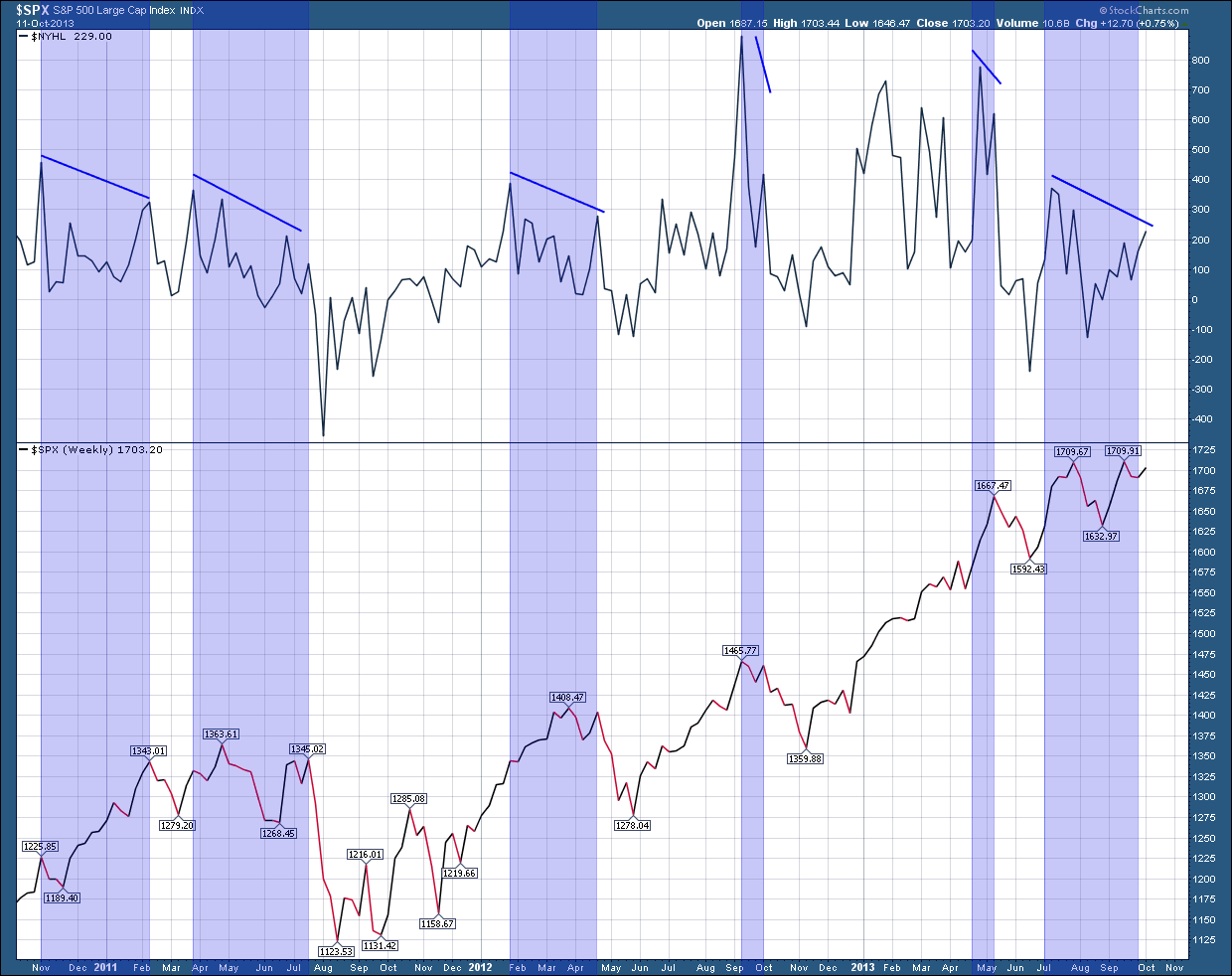
In the chart below, the upper pane is the AD line while the lower pane shows the price movement of the SP500 (US Stocks) index over the past 15 years.  I have highlighted, in blue, areas where the AD line declined but the SP500 (US stocks) rose.  As you know by now, this is called divergence and when divergence raises its ugly head, it warns a change may be ahead. As you can see, we are in a period where divergence has formed --- prices are rising and the AD line declining. So why does this matter and why do I watch this so closely?  With further analysis you can see that every time this has occurred in the past, stocks declined.  Not immediately but they declined.  So this gets the hair on the back of my neck standing up and I need to look deeper for further confirmation.

Now let’s go to the second chart which shows the number of stocks that are reaching all-time highs in price (new highs) which are plotted in the upper pane. In the bottom pane I have, once again plotted the SP500 index price as my proxy for the US stock market.  This is not too different from the first chart because over time the “new highs” line must either rise or at least stay flat if the stock market is going rise. The stock market index can’t continue to rise over time if the number of “new highs” decline. Higher prices in the individual stocks are required for the index to make higher prices.  As with the first chart I have highlighted, in blue, areas where the “new highs” line declines but the SP500 (US stocks) rise.  As with the first chart, you can see it does a very good job at giving advance warning that a correction could be near.

While these “internals” are not perfect at predicting the future, they are very good at giving us an advance warning of potential struggles ahead. Unfortunately, while they do raise a warning flag they don’t give insight as to when it will occur or how big a correction to expect.  In as much as we already experienced a mild correction over the prior 2 weeks to the debt ceiling debate, the question that comes to mind is it whether that correction is the extent of it or do we have more to come?  While I have been burned before in being too bearish on my concerns of a top, I am cautiously optimistic we are near an end of this correction and the two cyclical, seasonal bullish trends will provide the support the market needs to move ahead through the balance of the year and pushing the potential for a much greater decline into the first half of next year.

Oct. 14, 2013

As the “negotiations” on the debt ceiling continue in Washington, this week’s post comes from the Pew Research Center where they put together a really nice piece called “5 Facts You Should Know About the National Debt”. With the Republican-led House engaged in a stare-down with Senate Democrats and President Obama over raising the federal debt limit, it seems an opportune time to dig into the actual numbers describing the national debt, the debt limit and interest payments on the nation’s credit line:

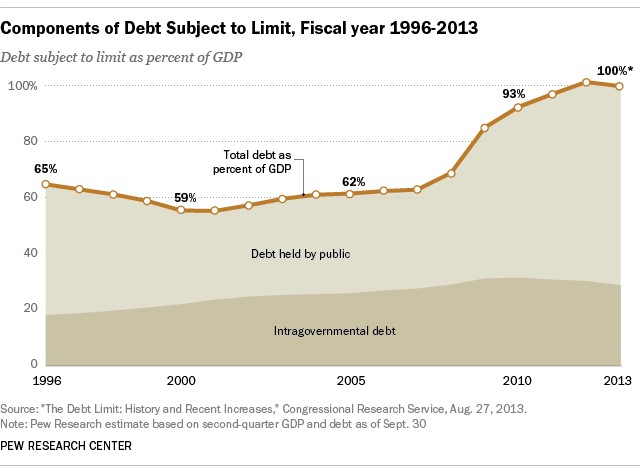
As of Sept. 30 the federal government’s total debt stood at $16.74 trillion, according to the Treasury Department’s monthly reckoning. Nearly all of it is subject to the statutory debt ceiling, which is currently set at a hair under $16.7 trillion; as a result, at the end of September there was just $25 million in unused debt capacity remaining.

The debt is about equal to gross domestic product (GDP), which was $16.661 trillion in the second quarter. (The government’s first read on GDP for the third quarter, which ended Sept. 30, isn’t due till the end of this month, but it likely will be delayed because of the federal shutdown.) Debt as a share of GDP has risen steeply since the 2008 financial crisis: Though U.S. government debt is perhaps the most widely held class of security in the world, as of the end of September 28.4% of the debt (about $4.76 trillion) was owed to another arm of the federal government itself. The single biggest creditor, in fact, are Social Security’s two trust funds, which together held $2.76 trillion in special non-traded Treasury securities (16.5% of the total debt). (Social Security revenues exceeded benefit payments for many years; the surplus was required by law to be invested in Treasuries.) The Federal Reserve banks collectively held nearly $2.1 trillion worth of Treasuries (12.4% of the total debt) as of last week.

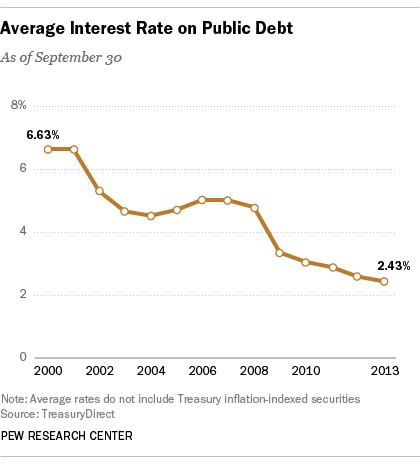
In fiscal 2013, which ended Sept. 30, net interest payments on the debt totaled $222.75 billion, or 6.23% of all federal outlays. (The government paid out an estimated $420.6 billion in interest, but that included interest credited to Social Security and other government trust funds, as well as a relatively small amount of offsetting investment income.) By comparison, debt service was more than 15% of federal outlays in the mid-1990s; the share has fallen partly because lower rates have held down interest payments, but also because outlays have risen substantially: up 39.4% over the past decade. Largely due to the Federal Reserve’s aggressive efforts to keep interest rates low, the U.S. government is paying historically low rates on its debt. In fiscal 2013, according to the Treasury Department, the average interest rate on the public debt was 2.43%. Though you might think such low rates would dissuade investors from buying U.S. government debt, demand has until recently remained strong. But the ongoing debt crisis may be changing that, especially for short-term securities.

BONUS FACT: Though many people may believe that “China owns our debt,” as of July (the latest month available) China’s Treasury holdings amounted to about $1.28 trillion, or 7.6% of the total debt. China is, however, the United States’ largest overseas creditor, ahead of Japan, which holds more than $1.1 trillion in Treasuries

Sept. 30, 2013

There's a world-famous value manager who stopped buying stocks in 2007 and started to hoard more and more cash. He was not predicting the Financial Crisis or the Credit Crash that would lead to a 60% drop for the S&P over the next two years. He simply couldn't find enough stocks to buy that fit his value parameters. That discipline helped him (and his clients) avoid much of the carnage that followed in 2008. The worst thing I could say about the current moment in the US stock market is that as value managers, like in 2007, we are struggling to find cheap stocks. The S&P 500 currently sells for a high market multiple historically and an even richer multiple considering what the growth picture currently looks like.

In the meantime, many value managers are increasingly hoarding cash - either because they can't find compelling values or because they foresee better opportunities ahead.

According to Bloomberg, it seems to be a trend:

The $1.1 billion Weitz Value and $980 million Weitz Partners Value funds each have cash stakes that are close to 30 percent. At the $10.6 billion Yacktman Focused fund, cash has crept up from 14 percent a year ago to 19 percent. The $1.3 billion Westwood Income Opportunity has about 16 percent in cash, more than double what it had at the start of the year. Cash makes up about 28 percent of assets in the $8.9 billion IVA Worldwide Fund, up from 10 percent a year ago, and is 33 percent of the $508 million GoodHaven fund, up from 19 percent a year ago.

There’s no big macroeconomic prediction fueling the move of these value managers into cash; just employing the simple investing discipline of rebalancing. The Leuthold Group reports that the median price-earnings ratio for large-cap value stocks is 13 percent to 25 percent above its long-term historic norm; large-cap growth stocks trade at an 8 percent to 10 percent discount to their historic norm.

Warren Buffett, according to the latest SEC filings of Berkshire Hathaway, he has raised and is sitting on, $49 billion in cash And in a recent interview he said, “Stocks have moved a long way. They were very cheap five years ago. That’s been corrected...We’re having a hard time finding things to buy.”

There are many differences between now and late 2007 before the crisis - but the current state of valuation is as clear as a bell. We're not cheap here and would benefit greatly from either a real correction in stock prices or a revenue growth spurt to justify current valuations.

Which is it going to be?

Sept. 23, 2013

As the markets are propelled higher by the successive interventions of the Federal Reserve it is hard not to think that the current rise will continue indefinitely.  The most common belief is the resurgence of economic growth will continue to propel stocks higher even in the face of higher interest rates.  The financial world has finally achieved a “utopian” state where there is no longer investment risk in any asset class – because if it stumbles the central banks of the world will be there to catch them. However, a quick look at history tells us that this time is not really different.  The reality is that markets cycle from peaks to troughs as excesses built up during the up cycle are liquidated.  The chart below shows the secular cycles of the market going back to 1871 adjusted for inflation.
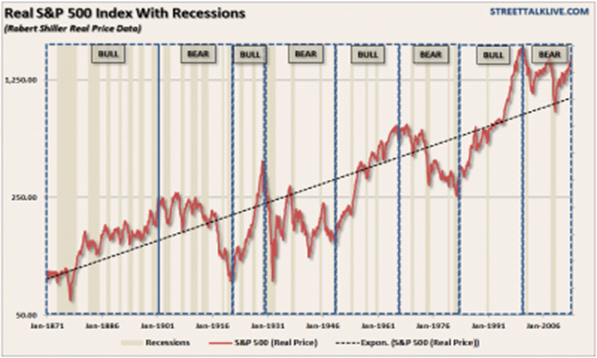
This time is not different.  The excesses being built up in the markets today will eventually be reverted just as they have been at every other peak in market history.  When?  No one knows but they will.

There are 10 basic investment rules that have historically kept investors out of trouble over the long term.  Some may fall out of favor for a period of time but over the long haul all 10 of these are “keepers”.  They are not unique by any means but rather a list of investment rules that in some shape, or form, has been followed by every great investor in history.

1) You are a speculator – not an investor

Unlike Warren Buffet who takes control of a company and can affect its financial direction - you can only speculate on the future price someone is willing to pay you for the pieces of paper you own today.  Like any professional gambler – the secret to long term success was best sung by Kenny Rogers; “You gotta know when to hold’em…know when to fold’em”

2) Asset allocation is the key to winning the “long game”

In today’s highly correlated world there is little diversification between equity classes.  Therefore, including other asset classes, like fixed income which provides a return of capital function with an income stream, can during normal market movement reduce portfolio volatility.  Lower volatility portfolios outperforms over the long term by reducing the emotional mistakes caused by large portfolio swings.

3) You can’t “buy low” if you don’t “sell high”

Most investors do fairly well at “buying” but stink at “selling.”  The reason is purely emotional driven primarily by “greed” and “fear.”  Like pruning and weeding a garden; a solid discipline of regularly taking profits, selling laggards and rebalancing the allocation leads to a healthier portfolio over time.

4) No investment discipline works all the time – however, sticking to discipline works always.

Growth, value, international, small cap or bonds all have had times when they topped the charts in terms of return.  However, like everything in life, investment styles cycle.  There are times when growth outperforms value, or international is the place to be, but then it changes.  The problem is that by the time you realize what is working you are late rotating into it.  This is why the truly great investors stick to their discipline in good times and bad.  Over the long term – sticking to what you know, have historical precedence and understand, will perform better than continually jumping from the “frying pan into the fire.”

5) Losing capital is destructive.  Missing an opportunity is not.

As any good poker player knows – once you run out of chips you are out of the game.  This is why knowing both “when” and “how much” to bet is critical to winning the game.  The problem for most investors is that they are consistently betting “all in all of the time.” as they are afraid of “missing out.”  The reality is that opportunities to invest in the market come along as often as taxi cabs in New York city.  However, trying to make up lost capital by not paying attention to the risk is a much more difficult thing to do.

6) Your most valuable, and irreplaceable commodity, is “time.”

Since the turn of the century investors have recovered, theoretically, from two massive bear market corrections.  After 13 years investors are now back to where they were in 2000 if we don’t adjust for inflation.  The problem is that the one commodity that has been lost, and can never be recovered, is “time.”

For investors getting back to even is not an investment strategy.  We are all “savers” that have a limited amount of time within which to save money for our retirement.  If we were 15 years from retirement in 2000 – we are now staring it in the face with no more to show for it than what we had over a decade ago.  Do not discount the value of “time” in your investment strategy.

7) Don’t mistake a “cyclical trend” as an “infinite direction”

There is an old Wall Street axiom that says the “trend is your friend.”  Investors always tend to extrapolate the current trend into infinity.  In 2007 the markets were expected to continue to grow as investors piled into the market top.  In late 2008 individuals were convinced that the market was going to zero.  Extremes are never the case.

It is important to remember that the “trend is your friend” as long as you are paying attention to, and respecting, its direction.  Get on the wrong side of the trend and it can become your worst enemy.

8) If you think you have it figured out – sell everything.

Individuals go to college to become doctors, lawyers and even circus clowns.  Yet, every day, individuals pile into one of the most complicated games on the planet with their hard earned savings with little, or no, education at all.

For most individuals, when the markets are rising, their success breeds confidence.  The longer the market rises; the more individuals attribute their success to their own skill.  The reality is that a rising market covers up the multitude of investment mistakes that individuals make by taking on excessive risk, poor asset selection or weak management skills.  These errors are revealed by the forthcoming correction.

9) Being a contrarian is tough, lonely and generally right.

The best investments are generally made when going against the herd.  Selling to the “greedy” and buying from the “fearful” are extremely difficult things to do without a very strong investment discipline, management protocol and intestinal fortitude.  For most investors the reality is that they are inundated by ”media chatter” which keeps them from making logical and intelligent investment decisions regarding their money which, unfortunately, leads to bad outcomes.

10) Benchmarking performance only benefits Wall Street

The best thing you can do for your portfolio is to quite benchmarking it against a random market index that has absolutely nothing to do with your goals, risk tolerance or time horizon.  Tom Dorsey summed this up well by stating that:

“Comparison in the financial arena is the main reason clients have trouble patiently sitting on their hands, letting whatever process they are comfortable with work for them. They get waylaid by some comparison along the way and lose their focus. If you tell a client that they made 12% on their account, they are very pleased. If you subsequently inform them that ‘everyone else’ made 14%, you have made them upset. The whole financial services industry, as it is constructed now, is predicated on making people upset so they will move their money around in a frenzy. Money in motion creates fees and commissions. The creation of more and more benchmarks and style boxes is nothing more than the creation of more things to COMPARE to, allowing clients to stay in a perpetual state of outrage.”

The only benchmark that matters to you is the annual return that is specifically required to obtain your retirement goal in the future.  If that rate is 4% then trying to obtain 6% more than doubles the risk you have to take to achieve that return.  The end result is that by taking on more risk than is necessary will put your further away from your goal than you intended when something inevitably goes wrong.

Sept. 16, 2013

Some quick background on the familiar Dow Jones Industrial Average (DJIA)- It is a stock market index, and one of several indices created by Wall Street Journal editor and Dow Jones & Company co-founder Charles Dow. The industrial average was first calculated on May 26, 1896. The averages are named after Dow and one of his business associates, statistician Edward Jones. It is an index that shows how 30 large publicly owned companies based in the United States have traded during a standard trading session in the stock market. It is the second oldest U.S. market index after the Dow Jones Transportation Average, which was also created by Dow.

The Industrial portion of the name is largely historical, as many of the modern 30 components have little or nothing to do with traditional heavy industry. The average is price-weighted, and to compensate for the effects of stock splits and other adjustments, it is currently a scaled average. The value of the Dow is not the actual average of the prices of its component stocks, but rather the sum of the component prices divided by a divisor, which changes whenever one of the component stocks has a stock split or stock dividend, so as to generate a consistent value for the index.

With that as a backdrop, it’s interesting to note there will soon be a major shakeup to the Index.  Goldman Sachs Group Inc., Visa Inc. and Nike Inc. will be added after the close of trading on Friday, Sept. 20. The companies replace Bank of America Corp., Hewlett-Packard Co. and Alcoa Inc., with the changes effective at the opening of trading on Monday, Sept. 23.

It marks the first “three for three” change to the index since Apr. 8, 2004. The last change to the index was the addition of Travelers Cos. Inc. and Cisco Systems Inc. on June 8, 2009.

The index changes were prompted by the low stock price of the three companies slated for removal and the Index Committee’s desire to diversify the sector and industry group representation of the index.

If anyone else is scratching their heads on why the DJIA can be at all-time historical highs yet virtually every company that started in the index is no longer in business, it is easily explained with the reshuffling and “gerrymandering” of the index by regularly replacing the worst performers with much stronger companies.

.