Mar 31, 2014 - Time to take a seat on the other side of the boat?

Ever since June of last year when Chairman Bernanke told congress of the likelihood that the FED would begin scaling back bond purchases (and thereby ending the support for low bond yields) the bond market has been in a tailspin.  Any student of the markets know they can overreact to news and overreact to this news they did. The chart below of the 30-year Treasury bond shows the magnitude of the decline, 17% in 3 ½ months which is a HUGE move for bonds.  The market mouthpieces were calling for the end of the bond market as we knew it. If this were football the refs would call a penalty for piling on.

What exacerbated the selloff was, as you can see in the 30 year bond price chart below, bond prices created a divergent high (1) (higher prices but lower momentum – identified in blue line in upper RSI pane) which was a warning flag even before Mr. Bernake said word one.  Bonds were headed down anyway and Mr. Bernanke’s comments gave them a big shove.

What we know is that when the sentiment is overcrowded to extremes the best short-term move can quite often be in the opposite direction.  Bond prices eventually bottomed in August (2) and spent the next 5 months building a base and chopping sideways. This basing pattern is something a technician looks for as if it actually is a bottom, it can present a very attractive entry point and profitable opportunity. As you can see late January bonds eventually popped their head up above the blue horizontal resistance (basing pattern) line but soon thereafter fell back down. This created a higher high (3) which, in addition to the higher low that printed in February (4), was the confirmation an investor should look for to let them know the short term trend has changed. There are no guarantees but this type of setup increases an investor’s probability of a profitable investment. Because I am working with other people’s money I prefer to add one more level of confidence before I commit to an investment which for me was for price to make a higher high.  That high at (3) was tested 2 more times which proved its importance and finally broke through this week (5). This was the confirmation I needed. These patterns are nice as they provide estimated price targets and this has one that ends at about 115.5 (6).  If this plays out the investment will conservatively provide a 5% capital gain in addition to the 3.5% yield this bond carries.  While this would be considered a “yawner” if you are talking about risk assets such as stocks, for a bond this provides more than what you would expect from a bond in an entire year.  While what I have is provided a conservative price target there is the possibility of even greater upside. If the stock market takes a long overdue breather there is no question some of the money coming out of stocks will find a temporary home in bonds and could be the catalyst to even higher prices.

With any investment It’s important to keep your expectations in check and the same is required here. This will most likely not be a straight line to 15.5 but rather a choppy ride. I have no question there will be a few times it will challenge our conviction. If I take the FED at their word and their promise to eventually raise rates but not until late 2015 or early 2016, I go into this investment managing as an intermediate term investment only (not buy and hold forever).  But until then or until the market tells me otherwise, I find this contrarian side of the boat a compelling, low-risk to reward opportunity.

Mar 24, 2014 - Biotech harbinger?

For the past 3 years, biotech stocks have been the darlings of the market. The compelling stories they present having the potential to solve the maladies and genetic imperfections of the human race have brought immense amounts of money into this sector. The chart below shows just over the past 3 years (through February of this year), biotech stocks have outperformed the SP500 index by more than 90%. That is an astonishing ~25%/year compounded differential.

One of the interesting back stories in the markets this week was the bearish action in Biotech stocks. While the SP500 index was making new all-time intraday highs (but failed to keep it at the close), biotech stocks were experiencing their biggest decline in a year. We all understand declines are a normal part of the markets ebb and flow and biotech’s have experienced their share.  Over the past 3 years Biotech’s worst year selloff’s have been; 2011 = ~ -24%, 2012 = ~ -16%, 2013 = ~ -12% . You can see that each year the selloff has gotten smaller and smaller which underscores their strength as investors jumped at the buying opportunity more aggressively each time they had the chance.

Last month’s beginning of the selloff was not much of a surprise as we had plenty of warning. You can see in the chart below we printed a divergent high (prices are rising while momentum is falling) on the 25th of Feb as we did in last year’s October sell off. In addition to that warning flag, when looking closer at the Feb 25th close, we formed a hanging man candlestick which was the confirmation that a (temporary) top was in and we should expect a change in direction. So far the 2014 decline has been ~11%. While we have broken the up-trending support line, we sit right on the 50dma which may be all this current decline needs to stop. If not, a logical next stop would first be 235 followed by 225.  If the market really gets going to the downside, major support exists at the 200dma which right now is at 215.

 What is especially interesting is looking at past selloffs over the last 3 years biotech stocks either coincided exactly with the timing of or lagged slightly behind the broader SP500 index.  This time it is leading. This, combined with divergent highs on the index, the bearish shooting star candlestick close on Friday, the huge increase in volume and the lack of near term support levels, I fully expect to see a few more bears come out of hibernation this next week.  The first question one must ask is if Friday's sell off is creating a major buying opportunity or the even bigger question is if not how long can the strongest sector of the index continue to fall until it begins to have a negative effect on the overall market and pull it down along with it?


Mar 17, 2014 - The ever shrinking investor time horizon

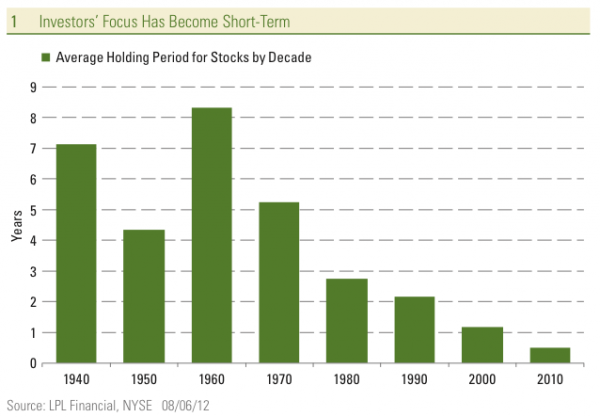
The attention span of today’s investors give ADHD a bad name and has driven an obsession with the short term.  The average mutual fund holding period has fallen by 75% over the past 16 years.  For stocks the data is even more bizarre as the average holding period has fallen from 8 years in the 1960’s to 5 days today.  One of the consequences of such a short investment time horizon is that investors have begun to fear short-term market events and volatility as much or more than the factors that shape prospects for long-term economic and profit growth that drive stocks over the longer term.

As such, investor’s patience with performance has followed the same declining trend.  While this may seem like the right thing to do, a study by the Brandes Institute showed this obsession with the short term a bad idea. Some interesting data from their study shows

Every best performing (10 year out-performance of SP>3% annually), long-run fund have had periods of major under-performance.

o   The average worst 1 year period was ~20% under-performance (6-38% range)

o   The average worst 3 year period was ~10% under-performance/year (1-20% range)

o   73% of these top performers found themselves in the lowest decile at least once

These types of results are not just unique to individuals who buy and sell mutual funds. Boyal and Wahal did a study on 4000+ decisions regarding hiring and firing of investment managers by pension plan sponsors. The results uncovered the classic hallmarks of returns-chasing behavior.  The managers the sponsors tended to hire had an average out-performance of nearly 14% in the 3 years prior to hiring. After hiring those same manager’s performance was statistically insignificant … meaning their performance matched the benchmark.  No out-performance.  In contrast, those fired for performance reasons had underperformed by ~6% in the 3 years leading up to dismissal. However, in the 3 years after the firing, they outperformed by 5%.

This helps illustrate that 1) even the best long term performing money managers run into short term difficulties 2) Investors need to insure they keep their focus on the long term as short term reactions can have long term negative effects on their portfolios.

Mar 10,2014

“A weed is but an unloved flower.” - Ella Wheeler Wilcox

We closed out 2013 with a bifurcated market. US stocks were the only place to be while the balance of the choices vying for your investment dollar were either ignored or beaten like that spider you found in your clothes drawer. As you can see in the chart below (2013 asset class performance) stocks were the only investment that ended the year higher (red). Commodities (purple) squeaked out a small loss, US bonds (pink) were shunned losing double digits while gold (light blue) was crushed.

2013 Untitled.png

A funny thing happened (at least so far) once we flipped the page on the New Year.  Through the first two months of the year it appears as if the 2013 losers have become this years darlings. Commodites and gold have outperformed stocks by almost 5x and bonds have also showed strength, doubling the returns of stocks.

Untitled.png

While 2 months is not long enough to confirm a reversal of fortune, it appears as if 2014 is suggesting a US stock over-weighted portfolio, unlike the past 3 years, may not provide the best returns.

Mar 3, 2014

It’s time again for the regular check-up on the state of retirement accounts in the US. Fidelity recently updated numbers for 2013, and while accounts have increased, the bottom-line still remains that the overwhelming majority of employees are still well underfunded for retirement.

The average 401(k) balance hit $89,300 at the end of the year, up 15.5% from $77,300 in 2012, according to an annual tally by Fidelity Investments. Most of the boost came from stock market gains as all three major stock indexes ended the year more than 20% higher.

People on the verge of retirement, ages 55 to 64 years old, saw their nest eggs grow to an average balance of $165,200 from $143,300 in 2012, Fidelity said. Savers with both a 401(k) plan and Individual Retirement Account managed by Fidelity had larger nest eggs, with an average balance of $261,400, up from $225,600 in 2012.

Even a balance of $261,000 is hardly enough for a comfortable retirement. And many Americans are much more woefully unprepared for retirement. A 2013 study by the Employee Benefit Research Institute found that nearly half of workers had less than $10,000 saved.

Here’s something I found interesting: part of the problem is that many workers are putting their retirement savings at risk when switching or leaving jobs by not rolling over the accounts to 401(k)s or IRAs. Of the roughly 800,000 workers with Fidelity accounts who left a job in the first nine months of 2013, 35% cashed out their 401(k) balances, as opposed to leaving the money in their former employer's plan or rolling it into a new 401(k) or IRA. While Fidelity said the statistic was "concerning," it was not a significant increase from previous years.

These cash-out balances averaged $15,500, and were especially common among young and low-income workers. More than 40% of participants between the ages of 20 and 39 and 50% of workers earning between $20,000 and $30,000 had opted for the cash. Unless workers use the funds to open an IRA account within 60 days, they get hit with significant taxes and a 10% penalty.

Ultimately this makes it harder for their savings to grow. For example, a 30-year-old who cashes out $16,000 could lose nearly $500 in monthly retirement income, assuming she retires at 67 and lives to the age of 93, Fidelity said. Plus, the 30-year-old would be hit with $3,200 in taxes and another $1,600 in penalties at the time she cashes out.

Such an impact is why it never hurts to reiterate that, especially for young savers with years of potential investment gains ahead, it is important to save, and save often. Though personal financial situations will be different for everyone, one literally can’t afford not to sock away for retirement.

Source: http://money.cnn.com/2014/02/13/retirement/401k-balances/index.html?hpt=hp_t2