Desperately Seeking Superman

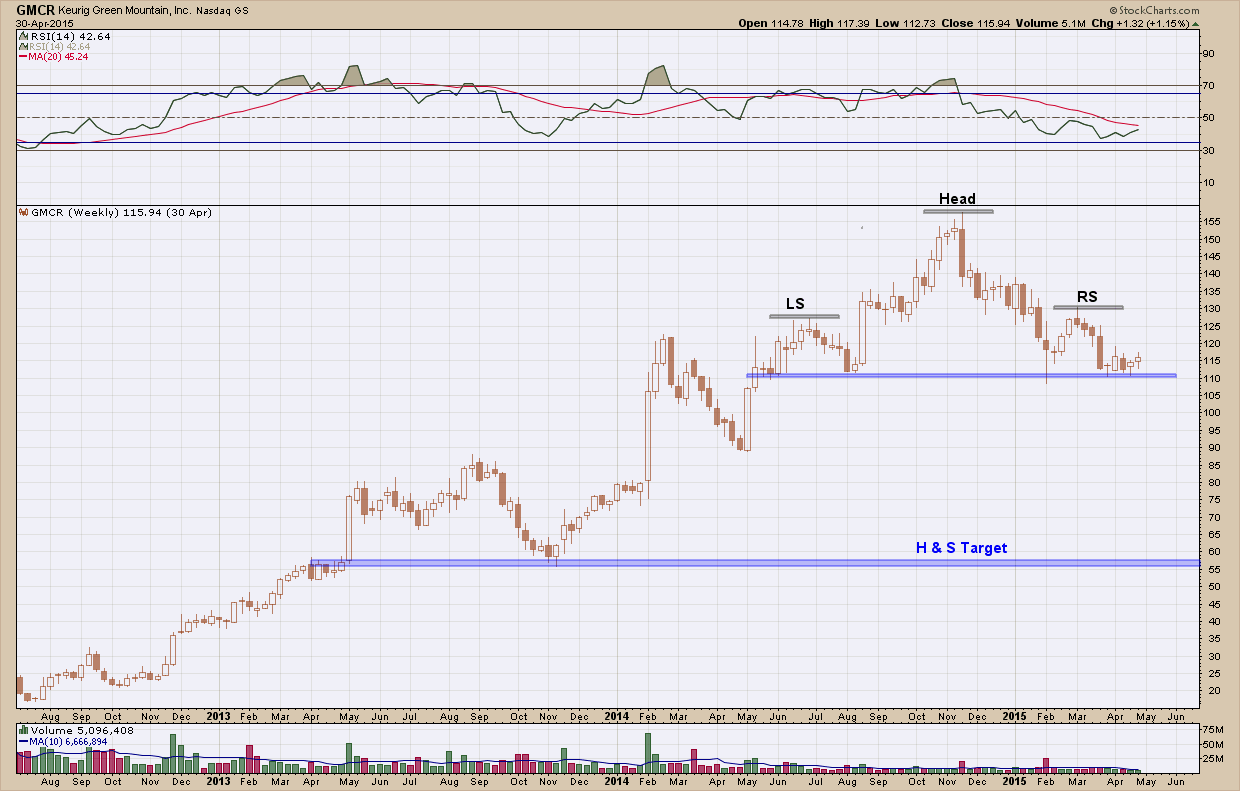
In case the name doesn’t ring the bell, Green Mountain Coffee Roasters (GMCR) manufactures the Keurig brand of coffee makers.  Its stock was a darling of Wall St. rising more than 900% in 2 ½ years, topping out in October of last year as you can see in the chart below. GMCR was consistently on every analysts buy list and made savvy investors a ton of money during the stock’s ascent. After topping, the stock began to fall and formed a text book, beautifully symmetric, head and shoulders reversal pattern. At the time, I personally bailed out of the stock and warned investors to sell because of the pattern target (highlighted and labeled with the blue horizontal line) downside was indicating the potential for a huge loss. I remember thinking at the time the decline, the potential for a 50% hair cut seemed completely unrealistic. This seemed especially true when considering the backdrop of it being such a strong company producing excellent results, loved by institutional investors and the overall market was still very bullish. As you would expect, as they are typically late to the party, and in spite of the technical warnings, analysts continued to push the stock.

One of the benefits of my training as a market technicians is I learned to not spit into the wind, tug on Superman’s cape, pull the mask off the Lone Ranger and most importantly not short a Wall St. darling stock in a bull market. As such I did not, in spite of it being perfect setup.  I was too chicken.
bay area investment advisor

Fast forwarding to today let’s check in to see what has transpired over the past 2 months since forming the right shoulder of the head and shoulders pattern. In the chart below you can see we have fallen almost 40% from the neckline of the pattern and it does not appear we are done. You can see in the upper pane, which shows momentum, we are so deeply oversold (it has never been this oversold in its history) that I expect to see a bounce higher over the next few weeks as it needs to unwind this condition. Once the unwinding is complete I expect the stock to follow a similar path to what I have illustrated on the right hand side of the chart by bouncing higher and then ultimately finishing its decline down to the pattern target around the 56-58 level. Where it goes from there is anybody’s guess and we will just have to wait and see what develops between now and then. The bottom line is those that were brave enough to take the  short are now up 40% in 2 months. I don’t need to remind anyone that is more than a 200% annual return.

Clearly, those who were bold enough to hold the position the entire way up and then short the breakdown have profited immensely. There are two things readers should take from this analysis 1) trend followers can make money in both up and down markets (if they aren’t chicken) and 2) every stock (even those who are revered by the Wall St pundits) have their days, weeks and months in the dog house – as such don’t fall in love with your investments.

Now that I have proven to myself making money shorting a Wall St darling is possible can anyone tell me where I can find Superman or The Lone Ranger?

Don't Fear the Reaper

The emotional scars from the past financial crisis still run deep and never really seem to go away.  This past week I received an email asking – “Will you protect me in the next bear market?” I am asked this so often that I should take a moment to comment.

When we lose money in any endeavor, including investing in the markets, it is not easily forgotten. Over the years, we all have taken our fair share of beatings in the market including me and 2008 still haunts. However, over time and, in spite of those past failures, I have figured out a way to move past it, carry on and get better.

Without risk, there is no reward. That’s the bottom line. While none of us will be able to reach the point that everything we do in the market is correct. Or, discover the holy grail of investing since no such thing exists. We can do some things that increase our ability to be successful. In my experience, it comes down to taking advantage of as many opportunities available while managing the risk properly to help us overcome when we are wrong.  Being wrong is ok, staying wrong is not.

Ten years from now, there will be many investors who will be filled with incredible regret - being hurt in the prior financial crisis and selling out and abandoning sound long-term investment strategies. Including failing to take full advantage of one of the greatest bull markets we may see in our entire lifetime. This cycle never seems to change. It’s those human fears and emotions which are our biggest obstacles to investment success.

It still saddens me greatly how many succumb to their emotions. Those who allow their feelings of fear and mistrust, prevent them from seeing opportunities that are right in front of them. Far too much money has been lost by people preparing for and fearing the worst, than simply focusing on what is actually happening. How do I know this?  Because some years back, that was me.

Without a doubt, things will change at some point and the bears will come to rule Wall Street once again. I am actually looking forward to that day, as I know all too well how to profit from such a bearish scenario. And when it comes the decline will happen very, very fast.  It always does.  But, until that next day arrives, my job is to focus on the market that lay right in front of us, right now in the present day. To learn from past mistakes and to focus on opportunities right now. If there is one thing you must do to do succeed in the markets, it is this.

Once you learn how to do that, you will be far ahead of those who are constantly expecting and looking for the reaper to come and ruin their life and take all of their money away. Remember, scared money never makes money and fortune favors the bold. This will always be true no matter what the market does next!

Greece is the Word

I had another post written for today on a completely different topic but considering Monday’s unprecedented move I thought it would be worthwhile addressing that instead as it likely has some readers nervous. The DJ Industrials fell over 2% as the drama of a Greek exit from the Euro (Grexit) reached a crescendo and launched investor’s fears into overdrive. Price stopped just under the 200dma and right at prior (S1) support. Volume was elevated, but surprisingly low for such a dramatic move.

bay area investment advisor pleasanton retirement planner

From Jani Ziedin @ TheCrackedMarket

No doubt the holiday-shortened week contributed to this slower than expected volume. Of course it would be more accurate to state it the other way; our slower than normal week contributed to this outsized volatility. When big money is on vacation, markets are often less stable, especially when spooky headlines get involved.

Two-weeks ago we traded near all-time highs when many investors assumed a Greek compromise was all but signed. This week we crashed to the lowest levels since winter as investors assume the Grexit is all but assured. This is a great example of why smart money trades against the herd. When everyone assumes the deal is done, then it is priced in and there is little upside remaining. That is the perfect opportunity to take profits and wait for the inevitable problems to arise.

Let’s get one thing straight, the Grexit is a non-issue for anyone not living and working in Greece. Our financial system had five years to manage, hedge, and otherwise reduce exposure to a Greek default. Most Greek debt is now held by European governments who can weather these losses. For them it isn’t a big deal because they didn’t enter into these positions expecting a profit, or even their money back. All they were doing is buying stability and time. And given that they delayed the inevitable Greek default by five years, they did a pretty good job. While a few politicians might lose their jobs and damage their legacy over this, the financial system will survive without Greece because of the time they bought us.

This may sound strange but corrections like we experienced Monday are not what should be focused on. Instead what is most important is what happens afterwards. As a general rule if the market cannot take back at least 50% of a big down move higher in the following 2-3 days (the fewer the better), it is likely you will be in for further downside. Further downside finds S2 (17000) is the likely target if that were to occur. If the markets want to really sell off, a reasonable low end target comes in at S3 (16000). Considering the current seasonality it is my expectation it is unlikely we will see a major sell off without participation by the big money (major institutional managers) who have started their vacation season and don’t return until September. With that in mind does it really shock anyone that the worst market month for stocks is September?

Bay area investment adviser

In the meantime the Greece debacle is not fixed, and closer to home we have our own “Greece” going on right here with what is happening in Puerto Rico. Normally summers are boring for market followers. Watching paint dry is typically more exciting but with the backdrop of these two developing saga’s I would recommend investors stay especially vigilant.

2015 - Who Stole the Volatility?

If you read my past posts you are familiar with my continual reference to muted daily volatility. The days of panicky buying or selling have been absent from the U.S. stock market so far this entire year. I have lots of ideas why, but that will be left for another day.

The Standard & Poor’s 500 Index hasn’t posted a gain or loss of 2 percent or more for 128 days, the longest streak since one ending in February 2007, according to data compiled by Bloomberg and Deutsche Bank AG. The last time the gauge went without a 2 percent move in the first half of the year was in 2005.

The last time U.S. stocks closed up or down more than 2 percent was on Dec. 18, last year when the S&P 500 climbed 2.4 percent. That week, Fed Chair Janet Yellen said the central bank is likely to hold rates near zero at least through the first quarter, sparking the biggest three-day surge in global equities in two and a half years.

Bay area financial adviser certified financial planner
The number of days when the S&P 500 rose or fell more than 2 percent (on a closing basis)

Investors waiting for big equity swings may be out of luck until September, with the Fed hinting they are not likely to raise rates until then, their first in nine years. Low volatility in this catalyst-heavy June is likely to be followed by more low realized volatility in the catalyst-light July and August if the Greece situation passes without contagion.   If not, get prepared.

After tripling between March 2009 and the end of last year, the S&P 500 is up just over 3% since then.  This has had the effect of creating the longest consolidation in the SP500 with a 4.6% range since 1950.

Certified financial planner retirement specialist

Long consolidation periods in stock indexes are typically bullish patterns that eventually resolve higher.  Where they tend to fail though is when they form at the top of a trend (something that is only known in hindsight) which is where we are now. Now is not the time to be lulled into complacency as that is usually when the market decides to shake things up. Invest Safe!