New Credit Cards are Coming

For something a little different -

After years of use in other countries around the world, chip-enabled credit cards are coming to the USA. Credit cards with only magnetic strips are being phased out ahead of an October 1, 2015 deadline.

If you have a credit card, you’ll probably get a replacement with a chip at some point soon if you have not already. The entire country won’t switch to chip cards by October 1, but retailers and banks that don’t will assume more financial liability.

How to Use a Chip Card

To use a chip-enabled credit card, you insert it in the bottom of a payment terminal and leave it there for the duration of the transaction. Importantly, the card needs to remain in the reader until the transaction finishes, not swiped like a magnetic strip.

While you’ll encounter payment terminals with support for both the magnetic strip and chip on modern credit cards, you can’t necessarily just use the magnetic strip. Try to swipe a chip-enabled card on such terminals and you’ll probably be asked to insert the card and pay via the chip method.

EMV Card Basics

Credit cards with chips use the EMV standard, which stands for “Europay, Mastercard, and Visa.” EMV is a global standard allowing chip cards to interoperate at point-of-sale systems and automated banking machines. (Despite the name, American Express and Discover are also participating.)

Know that the old magnetic strip isn’t going anywhere anytime soon. A chip-enabled credit card has an EMV chip as well as a magnetic strip. If you ever find yourself somewhere that only accepts magnetic strips — either in the USA or elsewhere in the world — you’ll still be able to use your card.

The magnetic strip can easily be cloned by swiping it, and that magnetic strip data can be copied to another card and used to make fraudulent purchases. A chip card works differently — it has a small computer chip in it. When the chip card is inserted into a payment terminal, it creates a one-time transaction code that can only be used once. In other words, chips can’t be duplicated as easily as magnetic strips. Any payment details would be stored with the one-time code. If the USA had transitioned to chip cards earlier, the disastrous Target breach could have likely been averted.

The October 1 Liability Shift

US banks have been issuing chip cards over the past year ahead of an October 1, 2015 deadline. After this date, a “liability shift” will take place. Any retailers that choose to accept payments made via a chip card’s magnetic strip can continue doing so, but they’ll accept liability for any fraudulent purchases. Any credit card issuers that don’t issue EMV credit cards will be on the hook for any fraudulent purchases, too.

In effect, Visa and Mastercard are telling banks and retailers that they can continue using the old system at their own financial risk. Not everyone will be transitioned over by October 1, but everyone who hasn’t will assume additional liability — that will encourage them to migrate as soon as possible.

This doesn’t affect your own personal liability — if your bank doesn’t issue you a credit card with a PIN before October 1, they’re assuming liability. That’s their problem, not yours. These details are all between retailers, banks, Visa, and Mastercard. But they explain why chip cards are getting rolled out so quickly.

EMV Cards Don’t Eliminate Fraud

Chip cards don’t eliminate the problem of fraud. In particular, these cards still have numbers, expiry dates, and three-digit codes on their backs. Someone could copy this information and use it to make purchases online. A chip-and-signature card could be used at a point-of-sale terminal along with a forged signature. The magnetic strip can still be used in the old way at many terminals around the world.

But, although chip cards won’t eliminate all fraud, they will make fraud more difficult. This will also help prevent future breaches of payment systems — like the one that happened at Target — from being so damaging.

Biggie Smalls

Just to be clear and insure I don’t lose anyone just because of the title, this blog post is not about the rapper, Notorious B.I.G but instead, small cap stocks. While it is not a perfect indicator (but hey, what is?), watching what the small cap stocks are doing provides a very good insight into the stock market as it speaks to investor’s willingness to take risk. During times of optimism and market strength small cap stocks will outperform their bigger brethren.  On the flip side when small caps are lagging that portends to a potentially bleaker outcome and investors should sit up and take notice.

Below is a chart of the US small cap stock index, IWM. In the upper pane is a momentum indicator RSI. In the middle is the price and the very bottom pane is the ratio of small cap stocks to the larger SP500 index.  Since their first peak in the 1st quarter of last year (on their first touch of S1) you can see small cap stocks have been consolidating going nowhere for almost an entire year and under-performing the SP500.  You can also notice at that time how far away price had gotten away from the blue uptrend line so a reversion to the mean back to that line should have been expected. The question as we consolidated was “is this just a normal, well deserved rest or something more?”  For me, if price broke both S2 and the blue uptrend line that would have told us the answer to our question as it would have been an indication we were in for something much more.  Instead, and right on queue price bounced exactly right off both support lines (red horizontal and blue uptrend) and we have not looked back since. Not surprisingly that "bounce" turned out to be the weekly low. Price eventually broke above S1, back tested it once and moved on to all-time highs. In the bottom pane you can see that since that weekly bottom print, small cap stocks have been on a tear outperforming the broader SP500 index by almost 10%.

investment adviser bay area financial planner

While event and seasonality driven corrections are always on the radar especially in today’s crazy geopolitical environment, this is a very bullish sign and combined with follow through in the coming week would go a long way towards alleviating much of my concerns we have reached the end of this bull market … at least for now.

Have a wonderful Father's Day!

Our Neighbors to the South

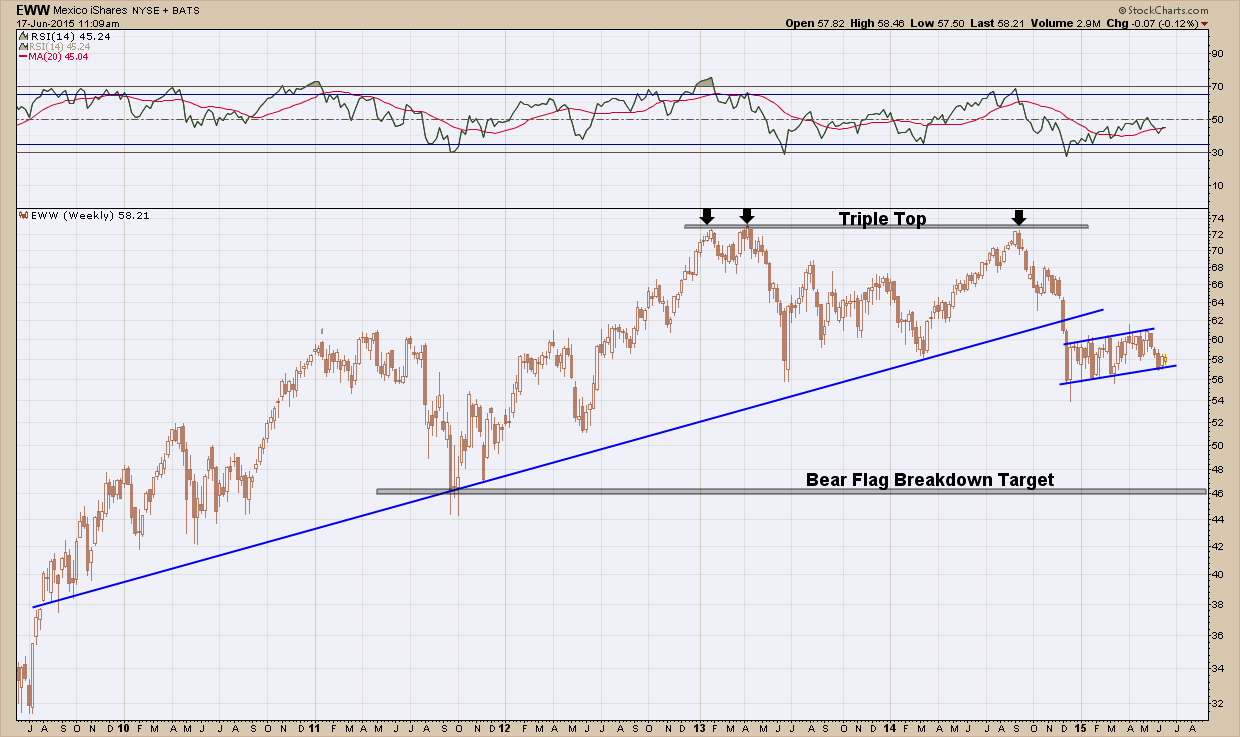
Checking in with the Mexican stock market I find a nice opportunity developing.  But probably not in the traditional way you have been trained to think. For trend investors it’s possible to make money in investments that are moving up or down but not sideways.  So, in this post I wanted to take a look at a short trade setup looking to make money as the price of a stock falls. I don’t spend a lot of time addressing these types of opportunities here in the blog because I am not able to short stocks for my clients but that does not mean others reading these posts shouldn’t learn and have the potential to capitalize.  What I am trying to teach is a process, not a specific trade or investment.  Remember ...

“You need to establish a process and stick to that process. You need to know what you’re going to do any given day and for any given investment scenario. Because if you don’t have a plan, when you get punched in the face by the market you’re not going to react well. Process is everything.”

The Mexico stock market ETF, EWW has been in rising uptrend since its bottom in 2009 and has stayed above its (blue) support line until the end of last year. After attempting to break higher three times and failing (creating the triple top), EWW fell almost 18% in the period of 3 weeks and found support at $56. Since then it has consolidated, chopping sideways (within the rising blue channel lines) frustrating the bulls and bears alike. It’s quite common to see consolidation patterns form just under a major breakouts (up or down) and this one is no different. This pattern, on a break below the bottom blue channel, has a projected target at the prior 2011 lows, $46. This works out to just over a 20% fall.

I love 20% opportunities.  There are, of course, no guarantees, but a nimble trader shorting the ETF on a break of below the channel with a stop back inside the channel would get a very attractive ~10:1 risk reward ratio and a chance for a 20% return.  I like those odds.

Bay area certified financial planner investment adviser

The Most Hated

At the end of a client portfolio review last week I ended the discussion with what I expected from the markets for the balance of the year. In summary what I said was based upon today’s current market trend and year end seasonal patterns my intermediate term expectations are bullish but I anticipate we will see a correction, maybe something as large as 10-20% in the short term.  I said this not because I was trying to predict the future but rather set expectation based upon probabilities of the fact it has been well beyond the average period between bear corrections. Like a rubber band the further you stretch it out, the harder it is to stretch it further and eventually it finally snaps.  Without taking a breath my client said “isn’t this what you said last year?”, and I immediately quipped “yes, and the year before that too”.  In all honesty these past few years have been very frustrating but have taught me to 1) accept the fact no one can predict the market’s future direction and 2) make sure you have an investment plan that works no matter what the market gives you. A couple of days after my meeting I read an article where  Ralph Acampora, the “Godfather of Technical Analysis”, was interviewed. Ralph is a pioneer in the development of market analytics and has a global reputation as a market historian and a technical analyst. He is a published author, popular lecturer and a leading international expert, consulted by prominent financial experts and journalists worldwide. He was asked about this current market and told the following story (which made me feel a lot better after reading it) …

I love to tell this story; in fact I have a picture of the man I’m talking about. The year is 1970; the man I’m talking to is Ken Ward. He worked for an old firm called Hayden Stone—you might remember that name.  He was a technical guru in his day.  I’m sitting next to him at this dinner and it’s like I’m sitting next to Joe DiMaggio. I was so excited.  By the way, he was 80 years old in 1970. That means he lived through every bull and bear market in the 20th Century up to that date and wrote about it. So I lean across the table and I say, “Mr. Ward, what was the most difficult market you ever had to experience?”  And then I said, “Oh, forgive me Mr. Ward, that’s a silly question, it has got to be the crash of 1929.” With a gravelly voice the old man says, “No. The most difficult market was the early sixties.”  I said, “But Mr. Ward, it went up.”  He said, “It sure did. We were all looking for a correction and it just kept going, climbing and climbing.” Sound familiar? ...

Here I am, 50 years later and I now understand what the man was talking about. The last year and a half for me has been very, very difficult because I haven’t seen a market like this. This is the most hated market I’ve ever seen and it’s persistent on the upside. I’ll gladly wait for a correction. But what we have in common with the early 1960s is low inflation and low interest rates. That’s the fertile ground that secular bull markets live in. I have a picture of him and me sitting there. I was 29 years old and I show that picture to everybody and I tell that story over and over again.

Crying Wolf

I have written many times in the past about rising wedges and their bearish implications.  In this unbelievably strong bull market prior rising wedges, for the most part have failed to follow through. So, at the risk of crying wolf and giving up providing a potentially important message, I am going to present another rising wedge that has raised its ugly head. If you stop reading here I fully understand based upon past failed examples but the way Murphy’s law works is that one time you don’t pay attention turns out to be the real deal.  So hear me out.

One of the strongest sectors of this 7 year bull market has been the strength of the Nasdaq 100, symbol QQQ. It’s an ETF that holds the top 100 technology stocks. So when this area of the market is telling us a story we should sit up and listen.

Let’s take a look at the daily chart below and see what it is telling us. The upper pane, price momentum, is providing a mixed signal as it is oscillating within the bullish zone but been negatively diverging with price since the start of the rising wedge. The bottom pane, volume,  is telling us distribution is slowly occurring as the selling volume is stronger of late. Indicators and volume are helpful and should be used as confirmation only because in the end the only thing that matters is price which is represented in the middle, largest pane.

Pleasanton investment advisor

Analyzing the price action two important bearish elements should jump out at you. The first being we formed a rising wedge (blue lines) and price finally broke below it today.  Secondly, we formed a double top at $111. Both of these patterns carry bearish implications. I have illustrated the chart with two horizontal red lines which represent very critical areas of support at ~$105 and ~$99.5 should the market want to fall further from here.  Very interestingly and coincidentally the projected move from both of these bearish elements projects the same thing, is a correction to the $99-$100 area, or right at S2. When a confluence of evidence points to the same outcome, that provides additional validity and importance to that outcome.

The inner investor on my left shoulder is telling me that any correction forthcoming is just a consolidation in an ongoing uptrend so no action is necessary. Sit on your hands, be patient and ride the long term trend.. The inner trader on my right shoulder tells me this bull is tired and that if today’s hammer close does not act as a reversal, this is a place to take some profits, take some risk off the table and consider adding a hedge to protect my portfolio.  So the question that needs to be answered is are we traders or investors?