The Fed Awakens

Now that the dust has finally settled from the Fed raising interest rates last week, some may be wondering what we might be in for based upon historical precedence of rising rates. I’ll start with the reassuring news. First rate hikes have been followed by higher stock prices over the following 12 months. Stocks have risen strongly when a rate-tightening cycle was started in response to economic growth. In the six 12-month periods starting in 1954 with core inflation characterized as low, stocks rose four times. Stocks rose every time when core inflation was low, bond valuations were high and interest rates were first raised.

Before you back up the truck, here is the asterisk. Though seemingly bullish for the current environment, the sample size is small. Plus, the current trio of a first rate hike, low inflation and high bond valuations has only previously occurred in 1954, 1958 and 2004. So while the record is favorable, it’s not a slam dunk. Since at least 1954 (if not further back), the Federal Reserve has never raised rates from such a low level. That's not to mention that large banks are currently being required to meet tougher capital requirements and oil remains in the doldrums, having traded below as $35 per barrel which was last touched at the 2009 bottom.

In 1954, the Korean War had recently ended and the Federal Reserve was just a few years past no longer having to monetize Treasury debt at a fixed rate. In 1972, Bretton Woods had recently ended and the Arab oil embargo ensued not too far afterward. In 1983, Paul Volcker was battling double-digit inflation. In 1998, the tech bubble was quickly enlarging. The point is that there are always events occurring that not only influence the decisions made by the Federal Open Market Committee (FOMC), but also how stocks and bonds perform after the rate hike tightening cycle begins.

What matters going forward is how the U.S. economy performs as well as the magnitude of future rate hikes and more importantly the pace at which they occur. The FOMC thought our economy is finally strong enough to withstand a rate hike, though inflation remains below its target. Globally, economic growth remains weak. China is slowing, while Europe and Japan are stagnant. Commodity-producing countries continue to be adversely affected by weak oil, coal and metal prices. If these conditions continue, it would be easier for the FOMC to justify gradual increases in rates, which Chair Janet Yellen suggested would be the path going forward.

Rising prices are nice, but the magnitude of the price gains is also important. Periods of monetary tightening are associated with small-cap stocks being adversely affected more than large-cap stocks, but both have realized lower, though—and importantly—still positive, returns. The sample size is small and while history often rhymes, the future has a tendency of unfolding in ways we do not expect it to.

Between robust employment gains, rate hikes, falling oil, and a strong dollar, the market cannot decide on a direction. This, combined with the fact we have a flat 200 day moving average leads to choppy markets where every breakout/breakdown fizzles and reverses days later. As I have stated in the past when in this environment it is best to just sit on your hands and wait for the existing trend to reestablish (up) or new trend to commence (down).

Looking at the US SP500 index

All year, the S&P 500 has been trading in a large trading range. More and more areas of the market are breaking down while fewer and fewer remain in good shape The last two months on the S&P 500 have been a microcosm of the entire year – the index has not really gone anywhere, but where ever it has gone it has done so quickly. This market continues to produce the feeling to me that we are experiencing a major topping process. 4 of my 5 indicators have provided a sell signal over the past 6 months and as a result has increased our cash position to the highest point of the year. Although a healthy year-end rally could easily reverse all damage.

As you can see in the chart below, the rounded top that has been developing for the past year has not been invalidated and is still in play. Until price can break above the 2130 prior high in May we are in an intermediate term downtrend. If we break below the 1990 first red horizontal support we are likely to see further downside and retest the 1870 August lows (lower red horizontal). A break and confirmation below that? Well let’s just say that will indicate a new short, intermediate and long term bear market has likely begun.  

bay area financial advisor, pleasanton financial planning for retirement

Stepping back and taking a look from the 50000 ft level, it’s a strange world as we sit only 6% from all-time highs and it feels like the market has caved in around us. With the year winding down and most of Wall St and traders unplugging their computers, market movements over the final two will be viewed with a skeptical eye. 2016 seems to me is setting up to be a doozy as it is unlikely we stay range bound as we have this year.   

Is this 2012, or 2008?

I have so many charts in the queue but one thing I have learned is news trumps the charts every time. With our esteemed Fed Chairwoman speaking Wednesday morning and the world markets on the edge of their collective seats awaiting to hear her every word, I will defer today’s post to the latest from Tom McClellan. He looks at the most recent past election period stock performance, a tale of two totally different outcomes, and extrapolates into which path he thinks we follow next year in his post “Is this 2012, or 2008?”

bay area financial advisor retirement planner

December 11, 2015

We are now less than a year away from the next presidential election, and the stock market’s behavior during election years can be pretty variable.  When a first term president is angling for reelection, he will typically try to spin the news in his favor, declaring victory for anything and everything that is happening.  Investors typically respond well to hearing good news all the time, and the market goes up. 

But when a 2nd term president is in office, investors have the guarantee that the next president will be new and unknown, and that makes them more nervous about investing.  So election years with a 2nd term president are typically more negative than with a 1st term president.

We have seen great examples of this principle during the last 2 presidential election years.  And that is the point for this week.  The SP500 price action for the past 3 years has looked a lot like the 2008-2011 period.  It has also looked like the 2004-07 period.  And now we are at the point where those two patterns diverge from each other, and the outcome for each was a whole lot different.  So it is important right now to figure which schedule the market is still on. 

Robert Frost once wrote about the two roads that diverged in a wood, and how taking the road less traveled made all the difference.  We might wish that we all had not traveled the road of 2008, but that is the more likely path for the stock market in 2016, given that it is a 2nd term election year. 

Zooming in closer, we can see that the plots of both prior patterns look very similar right up to the point where we are right now.  But going forward into 2016, they show entirely different patterns.

bay area certified financial planner retirement and investment management expert

So the market is at a decision point over which path it is going to follow going forward from here.  It has arguably been following both patterns up until now, but it cannot follow both patterns in 2016. 

As I survey the overall situation, I am persuaded that the market in 2016 will follow the more bearish path.  Here are the main reasons:

1. 2016 is a second term election year, and so investors will have to grapple with the certainty of an unknown new president.

2. We have already seen a RASI +500 failure for both the A-D and Volume RASIs, indicating that liquidity is weak.

3. The eurodollar COT leading indication calls for a down move into April 2016, and it does not show a final bottom until October 2016.

4. US federal tax receipts have already gone above the 18% threshold, which promises a recession.

5. The spread between German 10-year “bunds” and 10-year T-Notes has already turned down from a high level. 

6. High-yield corporate bonds have been extremely weak, which usually leads to illiquidity that bites the stock market.

Got Junk in Your Trunk?

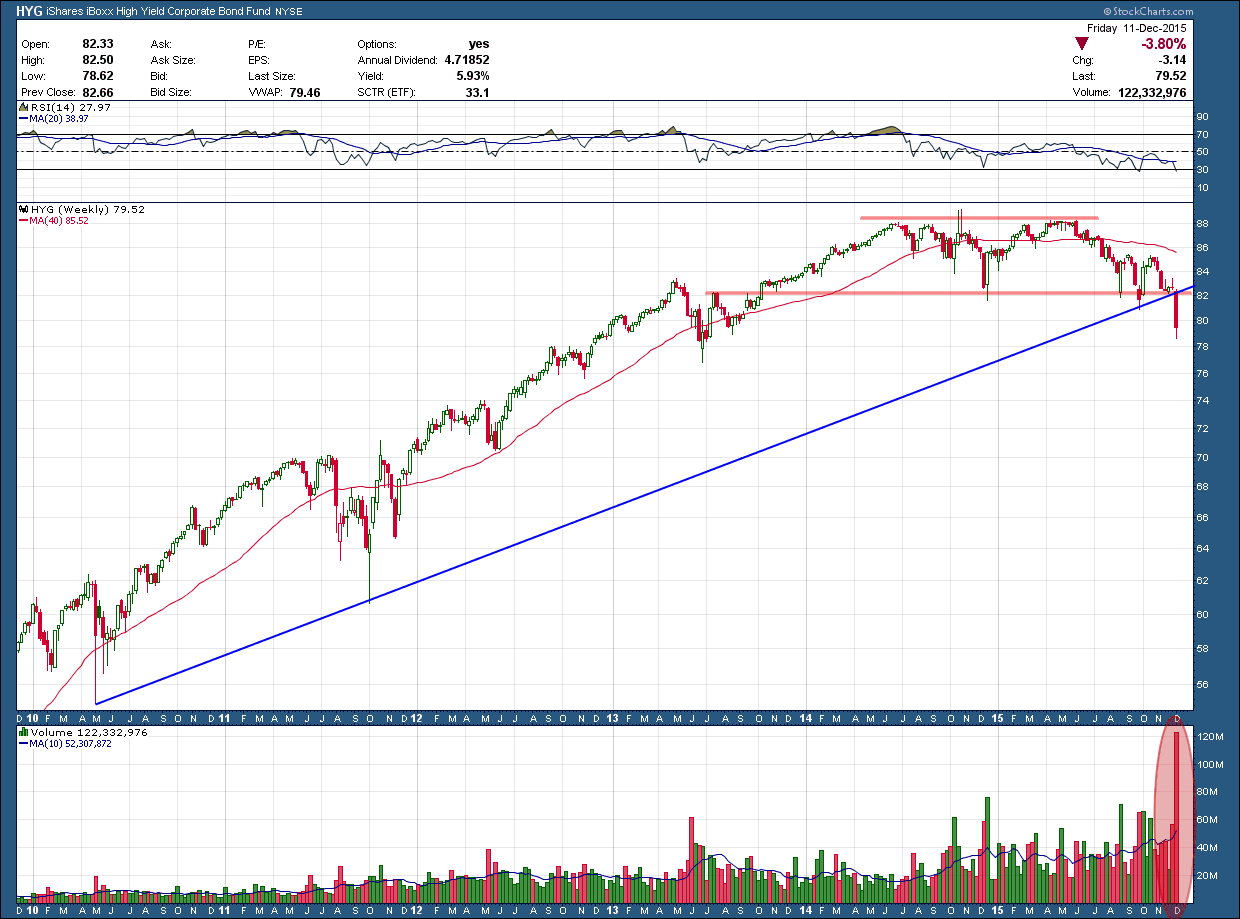
On last month’ video, I mentioned one of my biggest concerns after looking over the charts was the junk bond market. The concern was we were consolidating and once again testing the lower boundaries of the range.  A break below could not only push prices much lower but ultimately pull stocks along with them. The concern is the further oil falls and the longer the price stays depressed the greater the likelihood those companies who borrowed heavily to capitalize on the US energy boom will NOT be able to pay back their loans.  What happens then? The banks that lent the money will be on the hook. And, depending upon their leverage and exposure, could be setting up for another 2008-type crisis (that too was debt related, the difference was then it was housing debt).  We are not talking chump change as it is estimated there is 400 hundred billion of energy related junk bonds and half is now “distressed”

This past week stock market participants watched as crude continued its cascade lower pushing energy stocks even further and junk bonds joined the party with gusto. One junk bond etf I follow, HYG, broke down hard below both its rising (blue) and horizontal (red) support as I feared would eventually happen. Notice also how price is firmly below the red 200 day moving average which has now curled over and is pointing down. Volume was enormous, more than 3x times its long term average and the greatest in the history of this ETF.   

bay area financial advisor, wealth manager and retirement planner

Large volume is what you want to see to confirm once price has made a move of technical significance which in HYG’s case was its break of support. This setup is indicating we will likely see much lower prices ahead. While this is a very high probability setup, I have to admit there is one element that has me somewhat cautious. A major selloff accompanied by extra ordinary high volume can be a capitulatory bottom. Meaning, if the volume was so high there are no sellers left and there is only one direction it can go …. Up.  Of course the only way we will know is at some point in the future and we can look back and say to ourselves, “What a great buying opportunity that was”

Investors love junk in a bull markets as they not only get better than average income but also can participate in stock like appreciation. Unfortunately, what goes up can come down just as far. Regardless of the chance this is a capitulatory bottom, I see no reason, to own junk bonds in an aged bull market.

Price is All That Matters

In the early years of my technical analysis training every night one of my mentors would say either, “only price pays” or “price is all that matters”.  Hearing that same thing over and over again used to frustrate me to no end. Whaddya mean only prices pays? What about earnings?  What about the FED? What about the Greece default?  What about, what about, what about? Those things matter darn it!  After finding the nerve I asked what it meant. He said it meant that as an investor the only thing I should pay attention to is price because everything else was noise. While that sort of helped it still was not complexly clear. Not until many months later did it finally click. I saw this comment on stocktwits.com yesterday and after a good belly laugh I immediately flashed back to the “price is all that matters” discussion of years past. I wished I had this then as it may have “clicked” a little sooner. 

Hopefully, if it hasn’t quite clicked yet for you, it may help you. If not, a good laugh is almost as important. Keep in mind it is about interest rates when in fact it could be about any other topic OTHER THAN PRICE.  

bay area financial advisor investment maangement retirement planning expert

The bottom line is everything, other than price, can be used to support a bullish or bearish argument depending upon which side of the fence you are on. Everything whether it is earnings, the FED, Greece (and maybe even Donald Trump) is reflected into price. Since price is all the information that exists in the market why not simplify life, ignore the noise and focus only on it because it is the only thing that matters.