Dec 9, 2013

Most human activities have seasonal cycles. The stock market too, has seasonal cycles that have been powerful trends to follow over the long term. You have heard me mention the fact I believe the balance of the year and into at least the first month of next should be good based upon seasonal patterns. What I am going to do this week is provide you the basis for part of that view by looking back at the year-end strength normally seen in stock prices in December, known as “the Santa Claus Rally”. While it is not perfect here is a look at some of the SP500 Santa Claus rally statistics from the last 20 years.

80% (16 years) of the time December 31st ended higher than they started on December 1st

20 % (4 years) of the time December 31st ended lower than they started on December 1st

The 4 years in which the index ended lower looked like this

1996 – a 1.6% loss

2002 – a 6.1% loss

2005 -  a 0.08% loss

2007 – a 0.74% loss

No one knows for sure but there are many reasons why this year-end rally might happen. Some things that may contribute include 1) during the holidays people spend more money on gifts which boosts corporate earnings 2) year-end optimism 3) fund and institutional money managers do tax loss selling and restructuring of their portfolios for the New Year.

While it is not perfect the historical patterns suggest one should be fully invested in November positioned for a potential rally.  Even in the down years, the worst case scenario was a 6% loss. Even in two of the greatest bear markets, 2000-‘01 and 2008-’09 the markets took a pause from a severe downtrend to hammer out a positive return.


Nov. 25, 2013

Relocating in retirement is brought up often when we’re working with retirees, especially here in California, where the cost of living is much higher than the country average. The article below does a great job of breaking down things to consider from a taxation standpoint. Beyond your federal tax burden (which usually stays the same no matter where you live if you use the standard deduction) there are state, local, sales, property and inheritance tax variables also to wade through. So if you’re thinking about relocating in retirement -- in hopes of enjoying milder weather and lower expenses -- before you make a move, it pays to assess the overall tax burden of your future home. ---------------------------

No matter where you live, your federal taxes will be about the same if you take the standard deduction. But you'd be amazed at how much your state and local tax burden may vary from one location to another.

People planning to retire often use the presence or absence of a state income tax as a litmus test for a retirement destination. That's indeed one factor for retirees to consider. But higher sales and property taxes can more than offset the lack of a state income tax.

Seven states -- Alaska, Florida, Nevada, South Dakota, Texas, Washington and Wyoming -- have no state income tax. Two states -- New Hampshire and Tennessee -- tax only dividend and interest income that exceeds certain limits. But many of the remaining 41 states (and the District of Columbia) that impose an income tax offer generous incentives for retirees. If you qualify for the breaks, moving to one of these retiree-friendly areas could be cheaper – tax-wise -- than relocating to a state with no income tax.

Here are five other key tax factors to consider when comparing states as possible retirement destinations:

Taxes on retirement-plan distributions

Although most states that impose an income tax exempt at least a portion of pension income from taxation, they often treat public and private pensions differently. For instance, some states exclude all federal, military and in-state government pensions from taxation. Other states go even further, exempting all retirement income -- including distributions from IRAs and 401(k) plans.

Some states that tax pension income offer special breaks based on age or income. At the other end of the spectrum, several states are particularly tough on retirees, fully taxing most pensions and other retirement income.

Taxes on Social Security benefits

Depending on your income, you may be required to include up to 85% of your Social Security benefits in your taxable income when filing your federal return. But in recent years, many states have been moving away from taxing Social Security benefits. Fourteen states now tax Social Security benefits to some extent.

Sales taxes

Don't forget to include state and local sales taxes in your personal budget analysis. Some states exempt food and medicine; other states famously have no sales tax at all, while some will tax every dime you spend.

And keep in mind that the sales-tax pain doesn't always stop at the state level. Most states allow cities and counties to assess their own sales taxes.

Property taxes

Property taxes are a major cost factor, particularly for retirees living on a fixed income. The median property tax paid in the U.S. on the median U.S. home value of $185,200 is $1,917, according to the Tax Foundation.

Tax rates vary significantly from state to state and among cities in the same state. But many local jurisdictions offer property tax breaks to full-time residents, some based on age alone and others linked to income.

Check to see how the local jurisdiction generates property-tax bills. There are two key numbers to evaluate: the percentage of a home's assessed value that is subject to tax and the property tax rate. Note that, depending on the tax rate, a home taxed at 100% of its assessed value could have a lower tax bill than a property that is taxed at only 50% of its assessed value. For example, on a $100,000 property taxed at 100% of its assessed value with a 2% tax rate, the property-tax bill would be $2,000. If instead the property is taxed at 50% of its assessed value with a 5% tax rate, the tax bill would be $2,500.

Estate and inheritance taxes

In addition to the federal estate tax (only relevant to estates valued at $5.25 million or more in 2013), some states levy their own estate tax. Many of these taxes kick in at levels lower than the federal threshold. Wealthy retirees need to make sure their estate plans take into account both federal and state estate taxes, which can eat into the amount passed on to heirs.

In a handful of states, heirs have to pony up. States that levy an inheritance tax require heirs to pay taxes on inherited assets.

Nov. 18, 2013

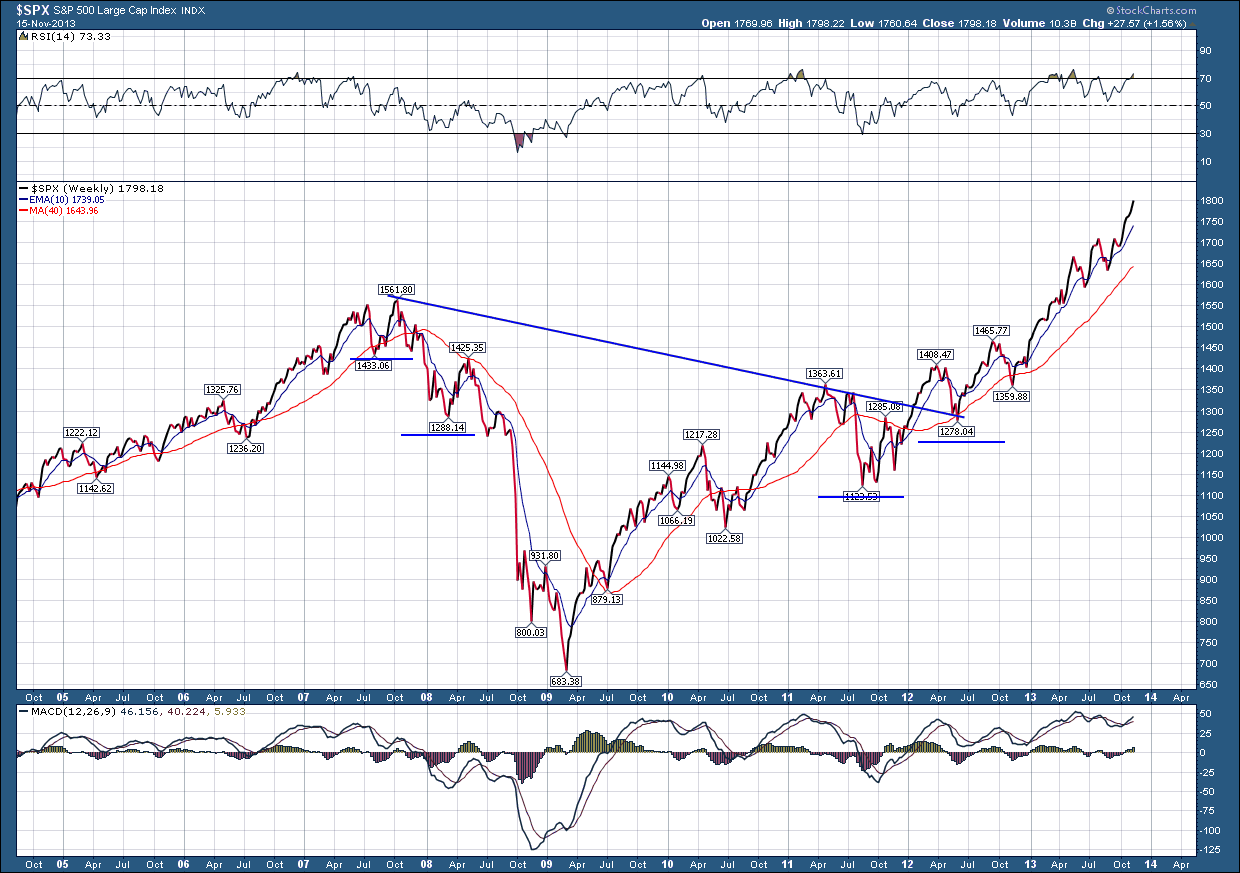
A good market technician will ignore all the fundamental arguments of why an investment should go up or down and focus solely on price. The basis for this is that all “fundamentals” should be built into the price of an investment.  In today’s world where information is available, almost instantaneously in fact, this reasoning has a sound foundation. I have been preaching fundamentals for years and have found out while they do matter in the long run, the short term on-the-other-hand can provide a completely different outcome. Starting with no bias or fundamental beliefs, thus weekend I took a long term look at two US stock indexes, SP500 and the Nasdaq and the results surprised me.

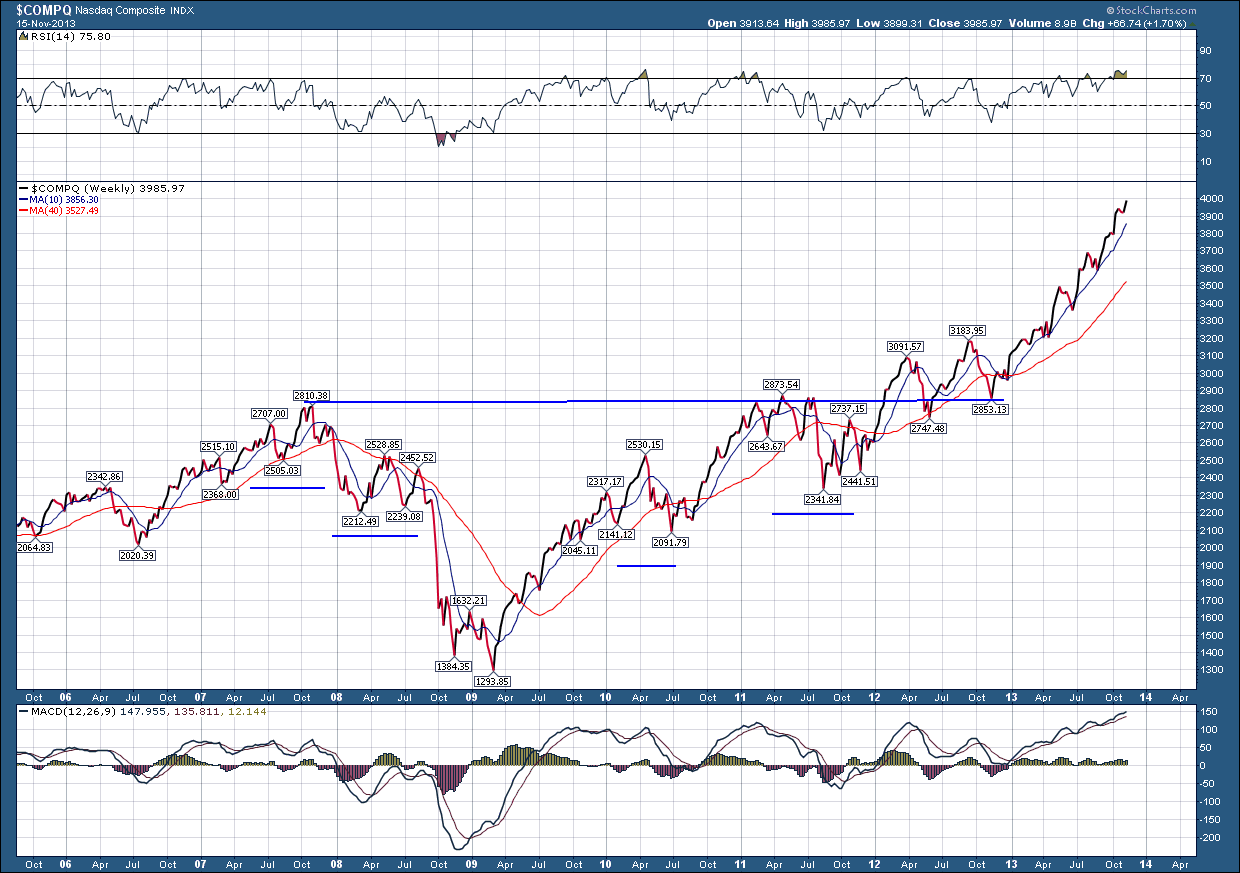
Below is the SP500 index sporting a very nice looking slanted inverse head and shoulders pattern which has a projected target of 2111, which is an increase of 19% from last Friday’s closing price

The NASDAQ has the exact same setup but a projected target of 4433 which is 11% higher from here.

While I am by no means predicting the future, I wanted to take an objective look at “possibilities” for the chance for further upside and if it existed, how much further.  What I discovered is the market has much more upside than I thought possible, so I need to adjust my views accordingly. By no means if we push higher and hit my targets or even go beyond do I believe it will be a straight moon shot there. I would expect to see the normal ebbs and flows of prices with the possibility of a short term correction (10% or less) between now and then.  In spite of the gamut of negative fundamental arguments (most of which I have addressed before), price says we have more upside.

Nov. 11, 2013

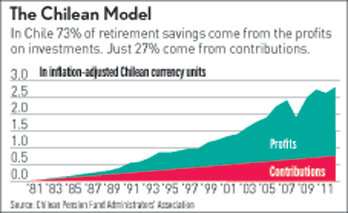
In Chile, a major study shows the nation's private retirement accounts provide worker’s pensions worth 87% of their salaries, 73% of that from profits on savings. The story was front-page news in Chile's largest newspapers, El Mercurio and La Tercera, on Sept. 3, a powerful affirmation of what former Republican presidential candidates Newt Gingrich and Herman Cain called "The Chilean Model" of private retirement accounts. The study of 28,000 households by Dictuc, a consultancy affiliated with the Catholic University of Chile, showed that male workers who contributed just 10% of their salaries to their retirements for 40 years or more on average earned retirement checks worth about 87% of their top salaries. No 401(k) account needed. This is because in 1981 Chile Labor Minister Jose Pinera replaced the country's bankrupt social security system with this famous system of private accounts. It redirected workers' existing social security taxes to a new market-based system of investing choices that let workers make their own decisions in a program run by private companies.

The Dictuc study shows Chile's private pensions over three decades have yielded returns six times higher than what workers got under Chile's old social security system — which, by the way, was similar to ours. The study shows that saving for retirement through the market is actually far less dangerous than relying on the government for pensions. Workers' returns on Social Security in the U.S. for those currently retiring is zero. For workers just starting their careers, the return is forecast to be negative as the trust fund goes bust.

More to the point, anyone who has to live on Social Security income alone is condemned to a life of poverty on those returns. The only alternative is for workers to double-down by opening 401(k) or IRA accounts.

Some 30 nations have adopted a version of Chile's private system. But in the U.S., detractors have warned that markets are far too dangerous to entrust workers' pensions to them. The details of the Dictuc study shatter this pernicious myth: Data show workers earn an extraordinary 8.7% compound rate of return above inflation over a period of 32 years from the 10% of their salaries put away. The compounding means that 73% of the pensions workers retire on comes from profit made on investments, with only 27% coming from their actual contributions. Profits accumulate even through market downturns, as was seen in 2008, because cost-averaging of investments cushions the impact.

Financial markets will never fall to zero, as scaremongers warn, except maybe if Armageddon hit. And if that's the case, Social Security would go bankrupt right along with it. There would be no economy to support it. With Social Security's trust fund slated to go bust in 2035 (or sooner depending upon which report you believe), maybe it's time to start thinking about how the lessons of Chile can benefit American workers, too.

Oct. 28, 2013

For the second straight year, millions of Social Security recipients, disabled veterans and federal retirees can expect historically small increases in their benefits come January.  Preliminary figures suggest a benefit increase of roughly 1.5 percent, which would be among the smallest since automatic increases were adopted in 1975, according to an analysis by The Associated Press.  Next year's raise will be small because consumer prices, as measured by the government, haven't gone up much in the past year. The exact size of the cost-of-living adjustment, or COLA, won't be known until the Labor Department releases the inflation report for September. That was supposed to happen earlier this month, but the report was delayed because of the government shutdown. The COLA is usually announced in October to give Social Security and other benefit programs time to adjust January payments. The Social Security Administration has given no indication that raises would be delayed because of the shutdown, but advocates for seniors said the uncertainty was unwelcome.

More than one-fifth of the country is waiting for the news.  Nearly 58 million retirees, disabled workers, spouses and children get Social Security benefits. The average monthly payment is $1,162. A 1.5 percent raise would increase the typical monthly payment by about $17.

The COLA also affects benefits for more than 3 million disabled veterans, about 2.5 million federal retirees and their survivors, and more than 8 million people who get Supplemental Security Income, the disability program for the poor. Automatic COLAs were adopted so that benefits for people on fixed incomes would keep up with rising prices. Many seniors, however, complain that the COLA sometimes falls short, leaving them little wiggle room.

Since 1975, annual Social Security raises have averaged 4.1 percent. Only six times have they been less than 2 percent, including this year, when the increase was 1.7 percent. There was no COLA in 2010 or 2011 because inflation was too low. The COLA is calculated by comparing consumer prices in July, August and September each year to prices in the same three months from the previous year. If prices go up over the course of the year, benefits go up, starting with payments delivered in January.

Advocates for seniors say the government's measure of inflation doesn't accurately reflect price increases older Americans face because they tend to spend more of their income on health care. Medical costs went up less than in previous years but still outpaced other consumer prices.