A Fundamental View

As a market technician my investment decisions are driven mostly by technical analysis.  That is not to say I do not use fundamental analysis, because I do. For me fundamentals reinforce rather than drive investment decisions. With that being said, I want to provide a rare fundamental chart that I am watching closely, that of stock prices and earnings. Investors have been told and conditioned to invest in stocks as long as earnings keep rising. The chart below illustrates how powerful the correlation is.

Bay area investment advisor - pleasanton financial planner

What should jump out at you is the path of corporate earnings (purple line).  Since the oversold 2009 bottom and the subsequent parabolic rise of both off their bottoms, earnings have followed a stair-step path higher. They step higher, level off, step higher, then level off. Wash, rinse, repeat. What should also be evident is that stocks lead earnings meaning stocks find tops and bottoms first. Since the beginning of this year when earnings took their last step up, stocks and earnings have gone in opposite directions. Earnings have declined slightly while stocks have gone (ever so) slightly higher.  

The bottom line here is we have a short term divergence in stocks and earnings which indicates the increased likelihood a correction for one of the two is in our future if this correlation is to hold. The question is which one?  Will stocks fall to synch with earnings or will earning beat estimates and confirm stock prices? Without question,n now that much of the uncertainties have been resolved (at least temporarily) surrounding Russia, China, Greece and the FED hiking rates, you have to believe this is an extremely important metric investors are now concentrating on.

What do you think?

Who Remembers 1904?

While the overall market continues to chop in a sideway range, when looking underneath the hood at individual stocks within the US Stock market it gets me concerned. As I wrote in April here we continue to see fewer and fewer stocks making new highs and an increasing number of stocks making new lows.  Unless this changes soon, we are headed for a correction (not a top or reversal) as the market is being held up by a minority of stocks (ie, Amazon, Netflix, Starbucks, etc).  In my daily analysis I monitor hundreds of stock charts and continue to see a similar story and as time goes on, with greater frequency … topping patterns followed by breakdowns.  Not every stock has topped or broken down but their numbers are dwindling.  Two weeks ago I wrote about Green Mountain (GMCR) here that had already topped and had fallen more than 40%. This week I wanted to show you a couple more charts that are in the beginning stages of their declines. I have been watching both of these for months seeing the short opportunity develop in slow motion.

My first chart is that of Franklin Resources (BEN). Franklin is a well-run asset management holding company providing equity, fixed income, balanced, and multi-asset mutual funds through its subsidiaries. You can see the stock rose more than 110% from the bottom in 2011, topping in Jan 2014. Since then the stock has been bouncing between the top and bottom red horizontal lines ($49-$58) over the past 18 months creating a triple top with negative momentum divergence.  This was a huge warning that a potential decline was in the cards. Friday it broke down below its bottom red support line and the bears pounced hard. If it does not reverse here soon, price will target T1 and, if weakness continues T2. For now, that is its targeted move. But, depending upon what happens forward, a much bigger bearish, head and shoulders topping pattern is developing with a more ominous target down to the lows of 2011.

San Francisco East bay area certified financial planner adviser

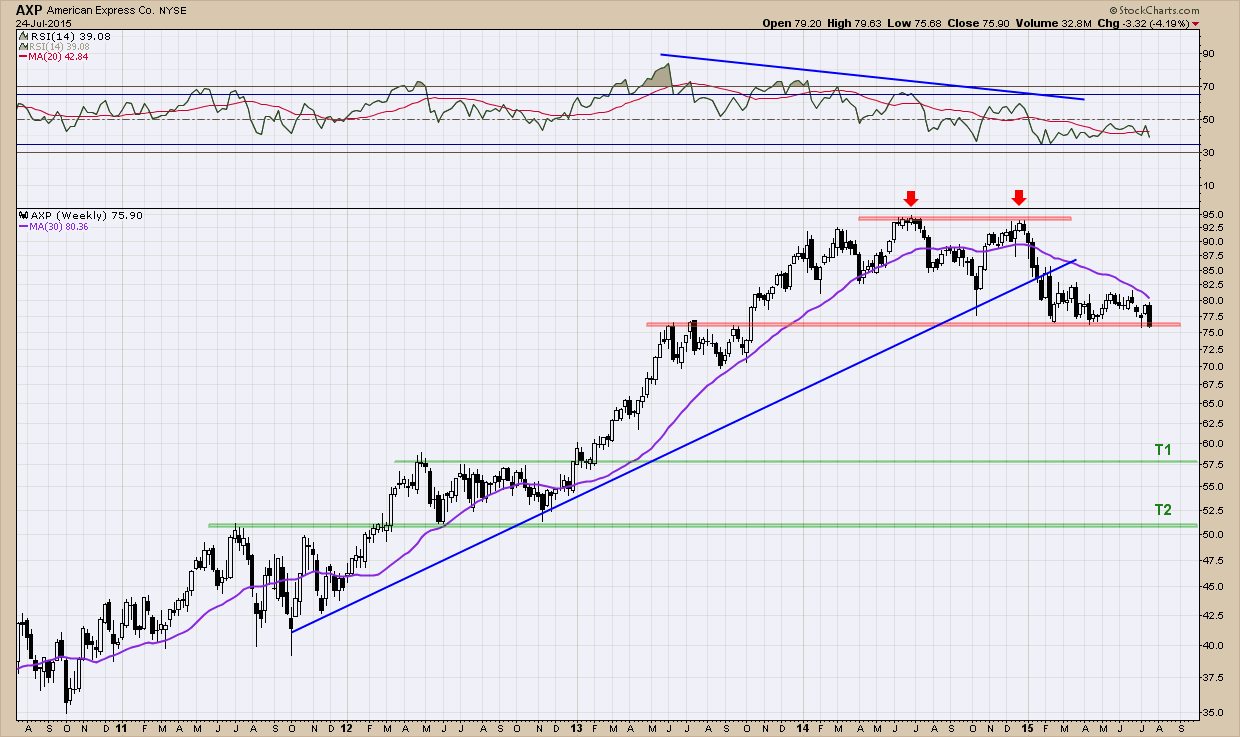
My second and last chart is that of American Express (AXP). As I am sure you all know American Express provides charge and credit payment card products and travel-related services. AXP rose 160% from its 2010 bottom topping in May of last year and like BEN above, has been bouncing between the red support and resistance lines and creating negative momentum divergence. Unlike BEN, it has formed only a double top and has yet to break down below its major support.  If there is follow through to the downside from here, T1 is my first target with T2 providing a likely home if the correction were to gain steam.

Pleasanton certified financial planning advisor

Stocks topping are nothing new as it happens in bull markets and bear markets so there is no underlying message here other than we have more data points to keep us cautious. Reviewing what they look like and recognizing them as they develop is a powerful skill that aids in preserving capital. Right now there is much to be bearish about but with every bull market there is always a wall of worry to climb. And this bull is no different. I continue to say, you need to give the benefit of the doubt to the current trend (which is up) and let your investment process, not a WAG, determine your market exposure.  Keep in mind you top-picking, semi-hibernating bears --- the S&P 500 did something in the first half of 2015 that it has not done since 1904 —it posted two consecutive (back to back) quarters of 0% gains. This has happened only one other time in the past 125 years, for either the Dow or the S&P 500 and the last time it did stocks surged 43% over the next two quarters.

Bear Trap

Below is the daily chart of Apple (AAPL) with price in the upper pane and # of shares traded in the lower.

You can see after testing the $105 level 3 times back in December and January, it used that last test as a springboard to propel higher as it climbed ~25% in a month, topping in late February. Since then it has been in a choppy, sideways consolidation zone bouncing between its top and bottom (red) rail.

bay area investment advisor

If you look closely at the blue circled area you can see price closed below the support rail on a 50% increase above the average daily volume. Areas of consolidation are stalking grounds for technicians, momentum traders and institutional investors as they are patiently watching for a break out of consolidation, signaling the possibility that a new trend has started. As such when you see a breakout (up or down), volume usually spikes as the quickest jump on the direction of the newly established trend.  The earlier you get on the more money you make.  That is, of course, it wasn’t a head fake.

You see, the market makers (MM’s) in a stock are playing a chess game against all investors.  They are in the business to make money and have survived by knowing crowd behavior and capitalizing on it. Knowing the levels of support are closely watched, especially on a company as well-known as Apple, they have been known to create traps for investors/traders. Let’s use the AAPL example at hand to illustrate a bear trap in action. As price approached the bottom rail the MM’s pushed the market down by selling enough shares out of their massive AAPL holding to have it break below that very important support level (~$122). Those watching the support levels noticed the breakdown and exited their long positions.  Additionally some jumped on the other side of the trade in an attempt to catch what they believed was the start of a new trend (down) and piled on short.  Since this is normal behavior what do those wily (rich) market makers do? Yup, they reverse it higher the next day above the support line trapping all those who went short the day before. Those that were not in the trade noticed the reversal and jumped on board the long side adding buyers and pushing prices higher. Additionally those that did short were forced to buy back shares to close out their short positions adding a whole lot more fuel to the rally. In the meantime the MM’s sold a few of his massive pile of shares to propel prices higher, in this case it has risen almost $12 in 7 days. 

The MM’s got rich ….  $12 x a whole bunch of shares is a big wad of cash …… in a very short time.  All in a day’s work. This, my friends, is a great example of a bear trap. 

In case you were wondering, yes there is a bull trap and many other ways the market can eat you alive. It’s a jungle out there with big game hunters (MMs) armed to take out both bulls and bears.

A Splash of Cold Water

The fact we held above the very important 2040 support line on the SP500 and rallied strongly since is very constructive on a technical basis.  But we still need to be cautious here as we still have the possibility to form a lower high and thereby have all the necessary elements of a trend reversal in place.  A close above 2126 would invalidate that reversal possibility (for now) so that becomes our key level to watch.

Bay area investment advisor

As we wait to see what actually develops for the second half of the month, we have the backdrop of poor seasonality patterns as a tailwind. As you can see below, July has tended to be the worst month for the US stock market with only 45% of past July’s closing higher than it opened.

Bay area financial planner investment advisor