What is Up With the Yen?

I got a call from a friend last week. She asked me about the yen and what I thought. I don’t look at currencies too often as they are pretty illiquid and minimally available in the securities market where client brokerage accounts are held. Additionally, no one will become rich investing in currencies in brokerage accounts so I tend to focus investment attention on stocks, bonds, some commodities and hard assets. Trading currencies is best done via FOREX markets because of the leverage they bring.

Being the natural skeptic I am, my immediate thought when she mentioned it was the yen, really? The dollar is so strong (right now) and the yen so weak there is no way! I pulled up a chart and was pleasantly shocked at what I saw because she was right. As you see in the chart below the yen has been basing for more than a year and has formed an inverse head and shoulders reversal pattern. Last week’s close was just above the neckline and what I would consider as a decent entry point upon confirmation. Add to that it has created higher highs and higher lows while price has risen above a flattened 200 day moving average which looks like it is now starting to curl up. These are all positive and things I need to see before I consider investing in something that has been in as severe a decline as the yen has. I do have my biases and would consider this a “trade” and not investment. I say this because fundamentally I don’t see a rising yen lasting as the Japanese government and central bank are doing everything possible to weaken it and until that changes I think it is doomed long term. For clarity, the difference between a trade and an investment is the time frame. A trade will be shorter in time, likely be a year or less probably months (they have even been as short as a few weeks) and an investment, longer. I prefer to avoid “trades” and hold out for “investments” in client accounts whenever possible.

As you know I try to not spend a whole lot of time on why an investment is doing what it is doing but in this case I am going to as there is a valuable lesson to learn and keep in mind. With the fundamental backdrop being so negative for the yen one has to wonder why it would be moving in the opposite direction it should be. Historically the yen is considered a safe haven (much like the dollar) during times of (stock) market stress and it appears that Mrs. Market is once again remembering that correlation

Bay area fee only independent financial advisor, retirement planner , CFP 1-18-16 FXY

Because the yen and stocks move in opposite directions, I would expect this yen rally to have some legs as I don’t think we are anywhere close to being done with the stock market decline. But once we are, I think this trade will likely have run its course.

Ay Carrumba

In June of last year I wrote about the double top in Mexico’s stock market ETF, EWW and the (blue) bear flag that was forming which I posted in the chart below. You can see at the time, I labeled the breakdown target from the flag with a black horizontal line which came in around the prior 2011 lows at ~$45. This projected to a 20-25% loss depending upon where you measured the starting point from (the top or bottom of the flag)

Bay area fee only financial advisor investement manager 1-14-16 eww #0

Fast forward to today with an updated chart below. You can see we hit the target not once but twice and sit just above the line.  This confirms how important this price as support as it has now bounced off 4 times over the past 4 years.

Bay area fee only financial advisor investement manager 1-14-16 eww #1

For those that followed along, congrats but it’s time to lock in the 20+% profit and move on. But is it? You see, when prices are strongly trending (in either direction) many times once one pattern has completed another one forms and EWW is no different. In this case we have now formed a very large, bearish complex head and shoulders topping (in red) pattern which brings with it a much larger potential for profit if it breaks down and you are short. A break and confirmed move below the neckline could be the beginning of the start of its next leg down. While it is hard to write this because it seem so implausible,  the pattern target projects down at around $20, some 43% lower than where we sit today and back right at the 2009 lows. If this works out all I can say is Ay Carrumba!

Double Diamonds

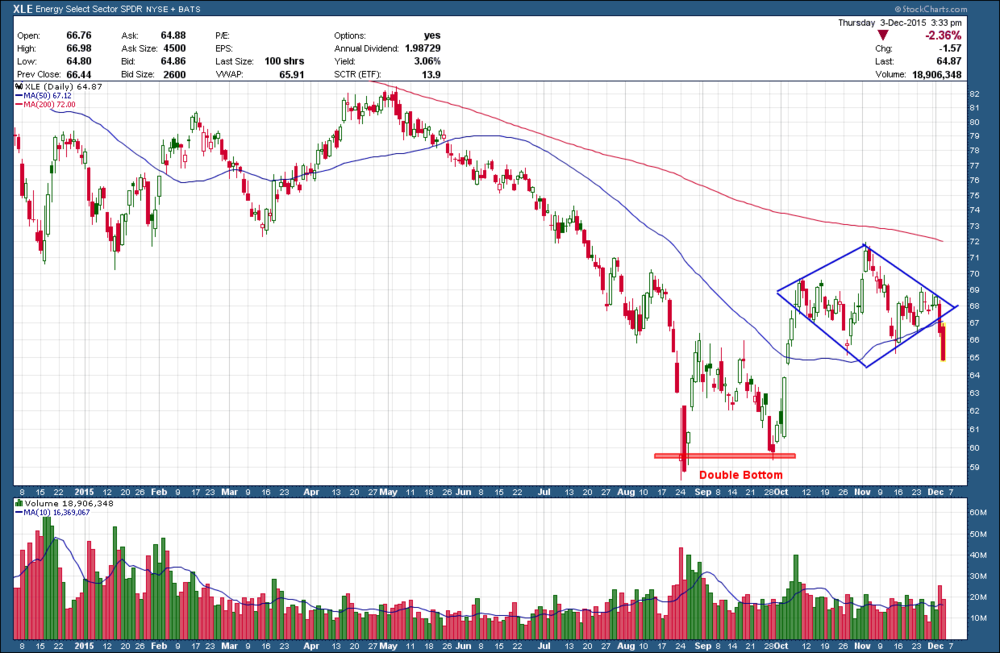
On December 4th I wrote about XLE, the energy ETF breaking out to the downside from the diamond reversal pattern which pointed to lower prices ahead. I stated “the pattern target is back down at the prior double bottom lows around 59 1/2.  I would expect short sellers to jump on board and add more strength to the downside so I would not be surprised by an overshoot of the target.”

investment advisor bay area financial advisor certified financial planner CFP

Revisiting an updated XLE chart below we can see that price bottomed at $58.85 nicely within the targeted area. Once it hit this level it found support (as expected) and began consolidating. Interestingly, during this consolidation it formed another diamond.  Not quite as symmetrical and pretty as the first, but a diamond nonetheless. This is the first time I have seen consecutive diamonds so I am not sure what additional significance if any it provides but I thought I should mention it. As you know, diamonds are usually reversal patterns but investors are best to wait for confirmation to see which direction price actually moves once out of the pattern before they put money to work (they are just back to back triangles which we don’t trust) . In this case, it appears as if it is not a reversal but rather a continuation as price broke, once again, to the downside. The target for this pattern is the width of the diamond subtracted to from its breakout price which, as it turns out, is at today’s lows.

financial advisor bay area investment advisor retirement planning specialist

Anyone who followed my recommendation is up as much as 22% depending upon their entry and should consider booking profits. I prefer to present blog ideas as they happen rather than after the fact. Unfortunately, this started to unfold as the overall market begin to unravel. In either case it can be used as a good learning tool for how to manage and invest in diamond patterns.

Bonds ... Where to From Here?

The consensus view is the FED will continue on their path to raise interest rates this year thereby creating a less than desirable environment for bondholders.  We know they only control rates on the short end of the curve so while it is a logical conclusion, it is not a slam dunk long term bond rates will rise in tandem if they continue to increase short term rates. This combined with the fact we have been told any future action will be “data dependent” investors must keep an open mind to the possibility of the long bonds rising in spite of the known “given” fundamentals.

Looking at the weekly chart of the 20 year US Treasury bond below you can see we have formed a symmetrical triangle with price coiling tightly, building energy as it approaches its apex. The $64k question is an investor wants to know the answer to is which way? Triangles are notoriously fickle and provide me little confidence on which direction price will eventually go once it breaks out other than you give a slight edge to the direction of the prior trend (which in this case is up). Either way it breaks, the projected target from the triangle is a move more than 10% which is pretty healthy considering this is a bond and not a stock.

investment advisor bay area certified financial planner CFP

My $02 (which should not be taken as investment advice) is I am a contrarian here. I think the weakness in stocks, the slowdown in recently released leading economic indicators and ongoing foreign currency devaluations will be ample fundamental reasoning to offset any FED action. I think we see long bond prices higher months from now.  But if I am wrong and the FED wins you can bet my investment dollar will be on the direction of the confirmed break out of this triangle not on any fundamental reasoning. When it comes to money it’s ok to be wrong. What isn’t, is to stay that way.  

Russian Support

Like many of the emerging market countries, especially those dependent for a large part of their economy on energy, the Russian stock market has been taken out to the woodshed. Since 2011, their market has lost more than 60% using the RSX ETF proxy. As you can see, after gapping down in August of 2011, price consolidated sideways for 3 years before its next leg down below support in October of last year. Since then price bottomed finding support in the 14 area, bounced higher retesting the 2011-2014 support area (~20) and quickly reversed, falling right back to where it sits today around 14. Today support exists at 14 and resistance at 20, this is a good example of a trading range. Momentum continues to be weak and within the bearish zone.

Bay area financial advisor expert retirement planning

What has my attention here is the (blue) bearish head and shoulders continuation pattern that has developed during this consolidation. I do have to confess the pattern is not quite as symmetrically ideal as I would like as the right shoulder is taking more time to develop than the left did. In addition to those expecting price to bounce here off support rather than continue down, the red 200 day moving average has flattened from a decline which is a slight positive. Further delay in breaking below the neckline will invalidate the pattern so it needs get going here real soon. While I cannot know every readers investment timeline or risk, anyone still owning RSX should seriously consider whether the 25% downside target potential on a break below the neckline is something they feel comfortable with and want to endure.